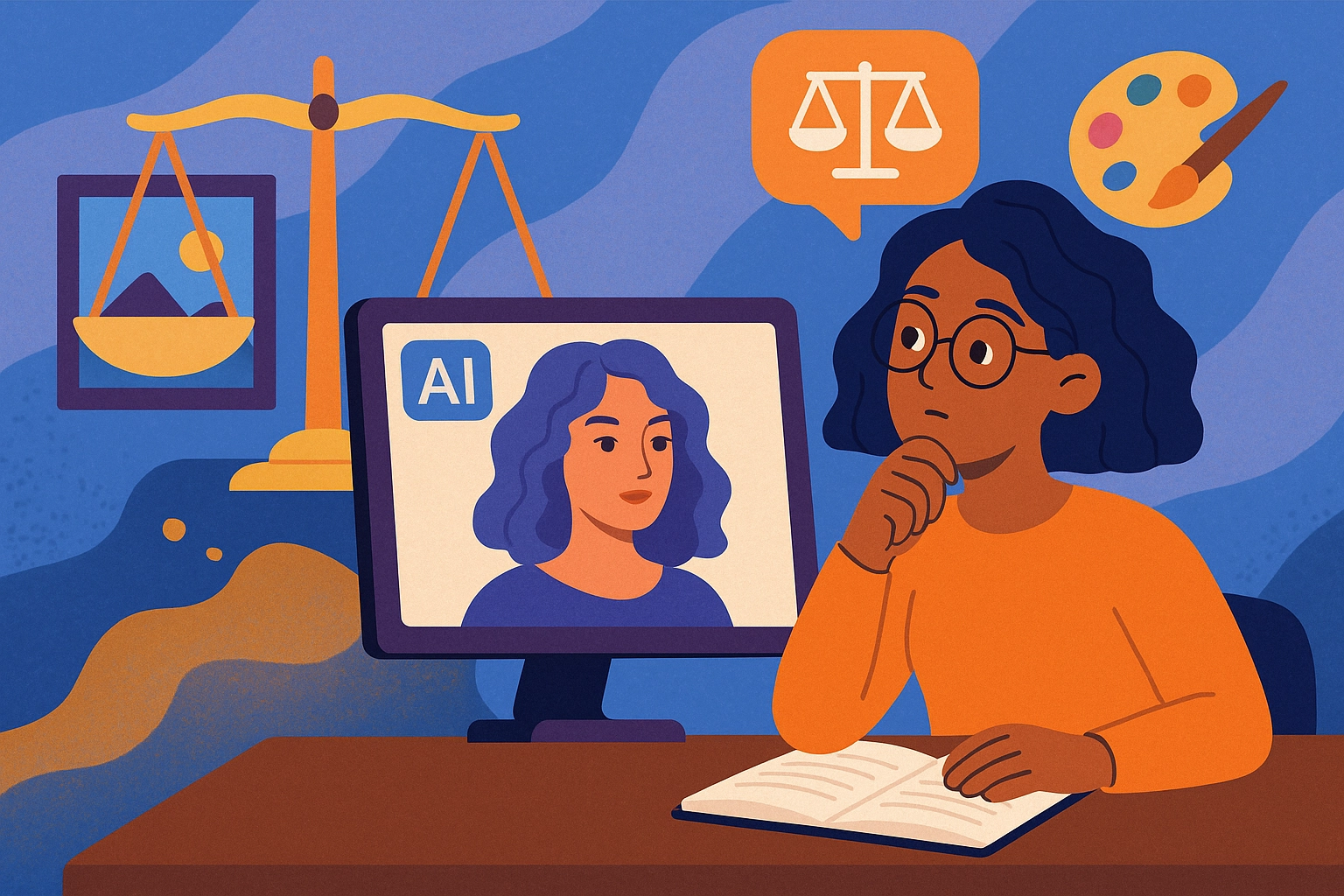
When a model can paint in your style overnight, who owns the canvas? In visual arts, AI has moved from novelty to infrastructure. That shift demands a deeper conversation. The question is not only what systems can generate, but what they should. This is the terrain of ai ethics, where creative possibilities intersect with rights, consent, and accountability.
In this analysis, you will learn how core ethical issues surface across the artistic pipeline, from data collection to distribution. We will examine consent and licensing for training data, authorship and attribution, and the economic impact on working artists. We will assess bias and cultural harms in visual datasets, as well as transparency, provenance, and disclosure practices. You will see how emerging regulations and industry standards shape responsibilities for artists, studios, platforms, and toolmakers. Finally, you will gain practical frameworks, including decision checklists, safeguards like content credentials and watermarking, and strategies for fair compensation and model governance. The goal is clarity on trade-offs, and actionable steps that protect creators while enabling responsible innovation.
Understanding AI’s Role in Visual Arts
Capabilities in painting and sculpture
Generative models, especially GANs and diffusion systems, now produce paintings that range from faithful style emulation to wholly novel aesthetics. A pivotal market signal came when the GAN-created Portrait of Edmond de Belamy sold for $432,500, validating AI as a collectible category and demonstrating how models trained on historical corpora can synthesize museum-grade imagery A Painting Made by Artificial Intelligence Has Been Sold at Auction for $432,500. Diffusion models add text conditioning, letting artists iterate quickly across palettes, compositions, and materials while retaining curatorial control. In sculpture, AI integrates with robotics and fabrication pipelines, from generative shape optimization to robotic carving and 3D printing. The humanoid artist Ai-Da illustrates this convergence, using computer vision and a robotic arm to realize drawings and sculptures that translate algorithmic decisions into physical form Ai-Da. For creative teams, a practical workflow pairs dataset design and prompt engineering with human selection and post processing, which preserves authorship intent while leveraging AI’s exploratory speed.
Market impact and ethical considerations
Generative AI is reshaping traditional art markets, audiences, and gatekeeping. In 2025, a dedicated auction of AI works featured 34 lots and totaled $728,784, surpassing expectations, with 48 percent of bidders from Millennial and Gen Z cohorts, a sign of new buyer demographics and broader cultural legitimacy Christie’s AI Art Auction Results. High value sales are no longer isolated, the Belamy portrait achieved $432,500, a Refik Anadol work sold for $277,200, and Ai-Da’s pieces have reached seven figures, evidence that AI art competes alongside traditional media. This growth arrives with AI ethics challenges that matter to visual arts, thousands of artists have protested training on copyrighted works without consent, and UNESCO’s 2021 global standard underscores transparency and accountability as norms. Environmental studies on arXiv highlight the carbon costs of training and inference, which curators should weigh in acquisition policies. Actionable steps for practitioners include crediting datasets and human collaborators in labels, using opt in or licensed training data, maintaining provenance records for prompts, models, and post production, and tracking energy use to prefer lower carbon pipelines. These practices protect trust while enabling the creative experimentation that communities like Creative AI Network exist to cultivate.
The Ethical Dilemmas in AI Art Creation
Transparency in AI-generated art
As of 2026, AI ethics in visual arts begins with transparency about datasets, provenance, and model behavior. UNESCO’s 2021 global standard elevates transparency, echoed by a 2024 survey of 459 artists calling for disclosure of training sources and profit flows artist transparency survey. Opacity erodes trust and clouds authorship and fair use, a problem spotlighted by litigation alleging training on web scraped images without consent lawsuit overview. Actionable moves include dataset statements and model cards, content credentials for provenance, and reporting compute and energy use to acknowledge the carbon cost of generative systems.
Bias and originality in algorithmic art
Bias in algorithmic art is measurable. A 2025 audit of leading text to image models found stereotyped depictions of professions and cultural markers in first pass outputs audit of text-to-image models. Such skew narrows aesthetics and marginalizes communities, while originality suffers when styles converge on identifiable living artists. Mitigations include bias stress tests and counterfactual prompts, balanced fine tuning with diverse datasets, and style distance metrics with release gates tied to fairness and novelty thresholds.
Consent and the ethics of using generative AI without permission
Using generative AI to imitate a living artist’s signature style without permission raises moral rights and reputational harms, even where copyright is uncertain. A consent first workflow reduces risk. Source licensed data, honor opt outs, and offer opt in programs with attribution and revenue sharing. Maintain training data inventories, creator registries, and prompt logs to support audits and dispute resolution. Within Creative AI Network, teams can codify these practices through exhibition checklists, provenance tags, and an ethics review for new datasets and collaborations.
AI’s Impact on Human Creativity and Expression
Automating creative tasks
AI now functions as a creative accelerator, handling routine yet time-consuming steps that previously constrained human imagination. By 2026, estimates indicate AI could automate up to 26 percent of tasks in art, design, entertainment, and media, including ideation sprints, mood boards, style exploration, and first-pass drafts of copy or storyboards, which shortens iteration cycles and opens room for higher order decisions by humans. See the analysis on automation in creative sectors in AI could automate up to 26 percent of tasks in art and media. In visual pipelines, diffusion-based models help generate composition studies and variation sets; in postproduction they assist with color matching and asset retrieval. Research further describes AI as a support system for problem finding, brainstorming, and reference gathering across the design process, expanding the breadth of options without replacing human judgment, see Journal analysis of AI as a creative support system. Practical tip: treat AI outputs as drafts, enforce a clear creative brief, log prompts and decisions, and schedule human critique checkpoints.
Concerns about threats to artists
Against these gains, artists report structural risks. Survey data shows strong demand for disclosure of training data and for clarity on who profits from AI-generated outputs, reflecting broader anxieties about consent and compensation. Analyses in 2025 suggest up to 20 percent of creative roles could be at risk, with freelancers facing the greatest volatility as clients swap commissions for low cost generated imagery, see Ethical debates and job risk estimates in 2026. Environmental costs also matter, since large-scale generation contributes to higher carbon emissions, and synthetic images can amplify misinformation if provenance is absent. Actionable safeguards include rights-respecting datasets, opt-in licensing, provenance labeling, and negotiated usage clauses that specify human-made deliverables.
Authorship and originality
AI’s generative capacity intensifies questions central to ai ethics. Who is the author when agency is distributed among model creators, dataset curators, and prompt authors, and what counts as original when outputs recombine vast corpora of prior works? Current U.S. guidance emphasizes that copyright requires meaningful human authorship, which makes documentation of human control crucial for enforceable rights. UNESCO’s global standard on AI ethics likewise points to accountability, explainability, and oversight as cornerstones for cultural sectors. For responsible practice, maintain detailed process logs, embed credits and intent metadata, assess similarity to references before publishing, and adopt revenue sharing or grants when community datasets underpin new works. Within our community, we encourage hybrid workflows that foreground human intent, then leverage AI to explore breadth, not to replace authorship.
Guidelines for Ethical AI Practices in Art
Build trust through transparency
Transparency anchors trust and provenance in AI art. Disclose when and how AI contributed, for example listing model type, prompts, and the scope of human editing, which aligns with guidance summarized in AI ethics in action. Provide concise explanations of system behavior, such as why a style was suggested, and publish model and dataset summaries or data sheets. Where possible, disclose lawful training sources and licensing terms, following frameworks like the responsible AI in art authentication. Add content credentials and energy notes; diffusion runs for high resolution images can be compute intensive, and recent studies link generative workflows to higher carbon emissions. Clear labeling also limits visual misinformation risk by signaling provenance.
Protect originality and authorship
Protecting originality starts with consent based data use. Use opt in licensing, fair compensation, and revocation clauses for training sets; maintain audit trails that connect outputs to underlying sources without exposing private material. Establish attribution standards that credit both human creators and the AI assisted process, for instance listing curator, model, and dataset contributors on exhibition labels. Advocate policies that reflect UNESCO’s 2021 global standard on AI ethics, which prioritized transparency and human rights, and pilot revenue sharing when datasets materially influence outputs. Studios can also cap memorization by deduplicating datasets and running nearest neighbor checks to avoid regurgitation of specific works.
Avoid bias to sustain inclusive creativity
Avoiding bias in creative AI is essential to inclusive cultural expression. Curate diverse training corpora spanning regions, eras, and underrepresented aesthetics, then document the coverage in a bias card. Test generators with stereotype probes across gender, ethnicity, age, and disability, and publish mitigation results alongside the model. Invite co design with communities that are most affected, and enable user controls that surface a broader range of styles rather than a single default beauty norm. The 2026 ethics conversation emphasizes trust, accountability, and governance; measuring and reporting bias performance turns those ideals into practice.
The Future of AI and Artistic Collaboration
Collaborations to watch
Human AI duos are moving from novelty to structured practice. In Los Angeles, the planned Dataland museum will foreground AI assisted works, ethical sourcing, and sustainability, signaling how institutions may scaffold co creation with curators, engineers, and artists under shared rules of consent and credit. Music experiments such as the AI singer Sienna Rose show that authorship is becoming multi agent and negotiated. Expect residencies where artists fine tune small models on consented archives, then co compose with them. UNESCO’s 2021 global AI ethics standard already informs these studios, especially around transparency and accountability.
Near term trends
By 2026, generative video and real time 3D will be standard in concepting, previs, and exhibition, cutting iteration cycles while elevating the need for provenance. The ethics conversation is shifting to trust, accountability, and governance, with creators piloting watermarking, model and dataset cards, and audience disclosures at point of experience, aligning with ai ethics priorities. Rights aware pipelines will link training data licenses to dynamic royalty splits. Studios will report energy metrics, since studies tie AI art to higher carbon emissions, and will prefer efficient fine tuning or on device inference.
New art forms and actionable steps
AI is enabling adaptive media that listens and responds, from gallery installations that learn from visitor choices with consent, to ensemble performances where a musician improvises with an AI partner. Personalized collaborators will be trained on an artist’s own corpus, producing distinct aesthetics rather than generic pastiche. To prepare, artists can draft a collaboration charter that defines data provenance, credit, and revenue share. Publish process notes with each work, and track compute and emissions, then set reduction targets. Finally, pool datasets within communities like Creative AI Network to co build ethical, transparent, and richly diverse models.
Key Takeaways and Actionable Steps
Ethical practice in AI art is no longer optional. It protects authorship, originality, audiences while sustaining trust in creative communities. UNESCO’s 2021 global standard on AI ethics foregrounds transparency and accountability, principles that map directly to dataset provenance and disclosure in visual arts. Emerging evidence links generative pipelines to higher carbon emissions, so environmental stewardship is part of artistic responsibility. Recent controversies, such as portrait apps that amplified narrow beauty norms, show how datasets can encode bias that artists inadvertently propagate. By 2026, the conversation centers on trust, accountability, and governance, which means artists need concrete habits, not slogans.
Start with disclosure. Credit models and datasets, share prompts and editing scope, and label outputs to curb misinformation. Respect copyright by using licensed or consented sources and avoid training on living artists’ styles without permission. Reduce footprint by favoring smaller models, batching inference, and tracking estimated kg CO2 per project. Build a studio checklist aligned with UNESCO, including bias testing on diverse faces and scenes, watermarking, and human review before publication. Finally, engage with the Creative AI Network, contribute case studies, join peer critiques, and help shape shared guidelines. Community feedback strengthens individual practice and elevates ai ethics across the field.
Conclusion
AI in visual arts is not just a technical shift, it is an ethical one. Key takeaways: consent and licensing must guide training data, authorship and attribution require clear provenance and disclosure, and the economic stakes for working artists are real. Bias and cultural harms in datasets demand active mitigation, while emerging regulations and standards define shared responsibilities for artists, studios, platforms, and toolmakers. You now have practical tools, from decision checklists to safeguards like content credentials and watermarks, to create responsibly.
Act now. Audit your datasets and workflows. Adopt provenance and disclosure practices. Align with relevant standards, and invite affected artists into your review process. If we design with integrity today, we can build an art ecosystem that is both inventive and fair. Choose to model respect in every image you ship.
No responses yet