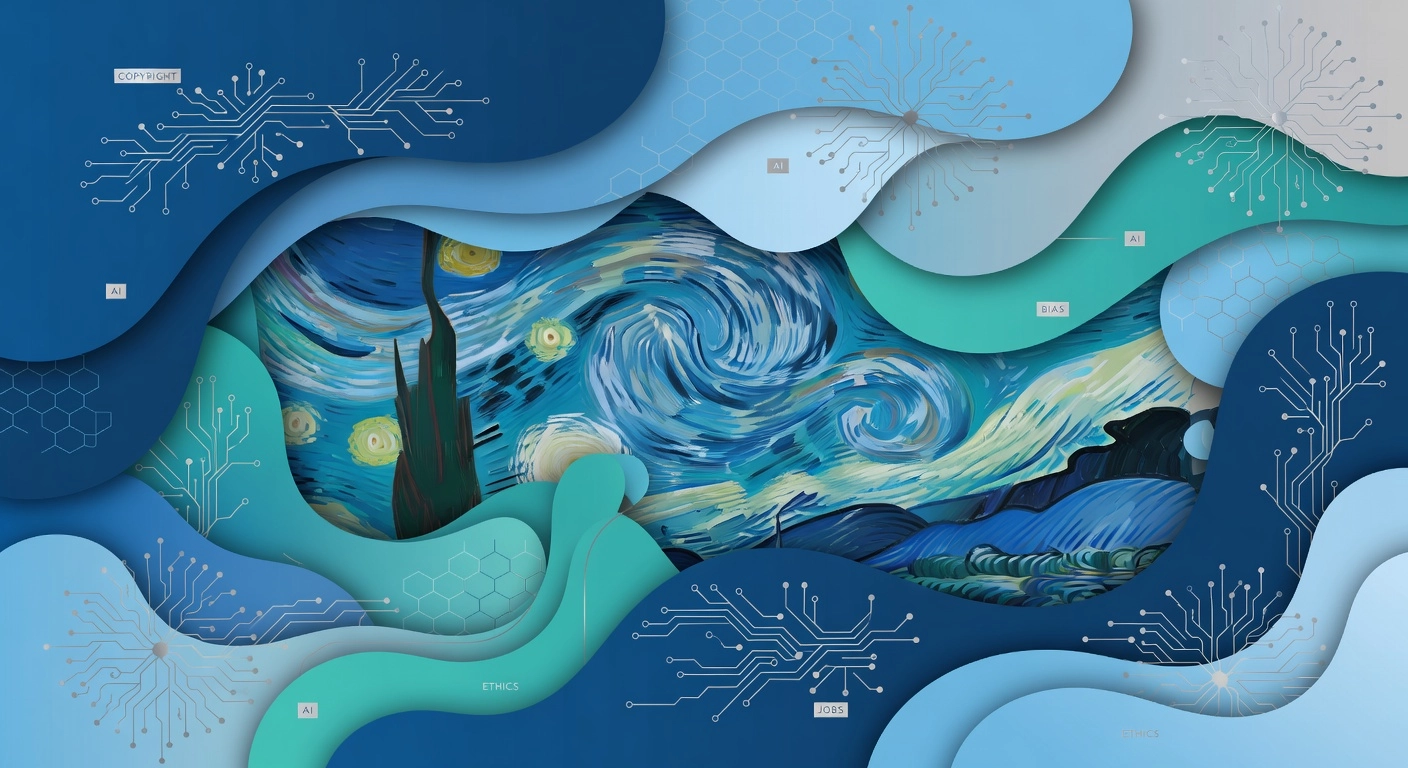
Imagine a world where algorithms conjure breathtaking artworks in seconds, mimicking the strokes of masters like Van Gogh or Picasso. These creations flood galleries, stock images, and social feeds, captivating millions. Yet beneath the pixels lies a storm of controversy. This is the ethics of AI art, a field exploding with promise and peril.
As AI tools like DALL-E and Midjourney democratize creativity, they raise profound questions. Who owns the copyright when machines remix human ingenuity? How do biases embedded in training data perpetuate stereotypes in generated images? And what happens to jobs for illustrators, designers, and artists whose livelihoods face automation?
In this analysis, we dissect these issues with rigor. You will explore landmark legal battles over IP rights, unpack the mechanics of bias in AI datasets, and evaluate economic forecasts for the creative workforce. Armed with evidence from court cases, research studies, and industry reports, you will gain a clear framework to navigate the ethics of AI art. Whether you are a creator, tech enthusiast, or policymaker, understanding these dynamics equips you to shape a fairer digital canvas.
Copyright Infringement and Training Data Issues
AI image generation models such as Stable Diffusion and Midjourney rely on enormous datasets scraped from the internet, often comprising billions of images without securing consent from the original artists. For instance, Stable Diffusion draws heavily from the LAION-5B dataset, which includes around 5.85 billion image-text pairs harvested automatically from public web sources like Common Crawl, bypassing permissions and stripping metadata such as artist names. This process involves unauthorized copying, filtering, and reproduction of works, raising serious copyright infringement concerns under frameworks like U.S. law (17 U.S.C. § 101). A Brookings Institution analysis labels this practice as “mass theft” in the visual arts, noting that over 6,500 artists and academics signed a 2025 open letter protesting the use of copyrighted works without compensation. The ethical stakes intensify with dataset flaws, including biases, harmful content, and memorized replicas that models can regurgitate, undermining the integrity of AI-generated outputs.
Artist sentiment underscores the urgency of these issues, with 89% believing current copyright laws are insufficient to address AI art challenges, according to Artsmart.ai data from 2024-2026 surveys. This view aligns with broader frustrations, as 74% deem AI-generated artwork unethical and 73% demand prior permission for training data use. Ongoing lawsuits amplify the debate: the class-action case Andersen v. Stability AI, Midjourney, and DeviantArt alleges direct infringement through scraped art training, proceeding to trial in 2027; meanwhile, Getty Images v. Stability AI contests the use of licensed photos in model development. Courts have mixed rulings, often favoring fair use for training but scrutinizing outputs, with at least 16 suits active by 2025. These battles highlight a regulatory gap, pushing for clearer protections in the rapidly evolving ethics of AI art landscape.
Emerging solutions like opt-out mechanisms and licensed datasets offer practical paths forward. Tools such as robots.txt directives, watermarks, and machine-readable signals enable artists to exclude works, though their scale-limited effectiveness weighs against fair use claims, as noted in the U.S. Copyright Office’s 2025 report. The Graphic Artists Guild’s 2025 Generative AI Ethical Use Guidelines advocate three pillars: credit (labeling AI involvement), consent (explicit permissions), and compensation (fair licensing), recommending opt-in platforms and anti-scraping tools like Glaze. Licensed alternatives, such as those powering Adobe Firefly or Shutterstock deals, demonstrate viability through consented stock images and collective licensing models that reduce transaction costs while allowing opt-outs.
These dynamics profoundly impact visual arts originality, as unlicensed training enables stylistic mimicry and market flooding, diluting human creativity’s value and risking “model collapse” from synthetic data loops. AI outputs often fail copyright tests for lacking human authorship, per Copyright Office guidance, challenging collaborative workflows. Fair compensation models, including extended collective licensing and revenue-sharing, emerge as imperatives; Brookings urges new human-AI copyright categories alongside disclosure mandates. For AI enthusiasts and professionals, actionable steps include registering copyrights, adopting ethical guidelines, and supporting licensed datasets to foster sustainable innovation at the creativity-AI intersection.
Authorship, Ownership, and Originality
The ethics of AI art extend beyond training data controversies to core questions of authorship, where U.S. copyright law demands human creativity for protection. The U.S. Copyright Office has ruled repeatedly that purely AI-generated works lack eligibility, as affirmed in its 2025 AI Initiative reports and court decisions like the D.C. Circuit’s 2025 rejection of Stephen Thaler’s AI-created “A Recent Entrance to Paradise.” Detailed prompts alone do not qualify as authorship; only substantial human modifications, such as editing or arrangement, enable partial registration. The 2026 NO FAKES Act builds on this by targeting unauthorized digital replicas of likenesses, mandating platforms to filter deepfakes and disclose provenance via standards like C2PA metadata, with penalties up to $750,000 per violation. These developments ensure hybrid human-AI works gain traction while pure AI outputs enter the public domain, prompting creators to prioritize verifiable human input. For deeper insight, consult the U.S. Copyright Office AI guidance.
Ownership fragments across the AI art pipeline, complicating rights attribution. Prompt creators secure limited claims based on input level: basic descriptions yield nothing, but iterative refinements or post-generation edits offer protection for human elements. AI companies retain model ownership and often claim perpetual licenses from user inputs per terms of service, yet face liability for infringing training data. Original artists from scraped datasets assert rights through lawsuits, as seen in ongoing Midjourney cases; the 2023 Andersen v. Stability AI et al. suit advanced direct infringement claims in 2024, alleging models store compressed copies of billions of images, while 2025 actions by Disney and others target character reproductions. Lanham Act violations for style mimicry proceed, underscoring splits where training artists seek compensation denied during data harvesting. A 2026 Artlist survey reveals 36% of creators prioritize clarifying these ownership rights amid rising litigation.
AI art’s rise dilutes human originality, homogenizing outputs and eroding emotional resonance. According to a Gitnux 2026 report, 87% of creators argue AI lacks the depth born from personal experience, replicating styles without contextual intent or soul. This aligns with broader data: 81% of designers see AI dulling creativity, and 78% note uniform aesthetics that fail to connect with audiences. Surveys show 42% validate AI-assisted art only with heavy human guidance, rejecting pure generations as soulless. In visual arts, this manifests as “AI slop” flooding markets, where one in three illustrators reports lost work averaging $12,500, per a 2025 AOI study. Creators must counter this by emphasizing process transparency to preserve authenticity.
A promising solution lies in blockchain for royalties and provenance tracking. Immutable ledgers could embed metadata on prompts, edits, and data sources as NFTs or C2PA stamps, enabling automatic micro-royalties, such as 10% to training artists on resales. Platforms like emerging GenX AI tools already integrate this for verifiable chains from creation to market. For details on court affirmations, see the D.C. Circuit ruling on AI authorship. This framework balances innovation with fairness, empowering ethical AI art practices. As adoption grows under EU AI Act mandates, it fosters trust in human-AI collaboration.
Job Displacement and Economic Impacts
Threats to Artists’ Livelihoods
The ethics of AI art intersect sharply with economic realities, as generative tools automate tasks once reserved for human creators, directly imperiling livelihoods. A pivotal 2025 survey by the UK’s Association of Illustrators (AOI), polling nearly 7,000 artists, found that one in three illustrators lost commissions to AI alternatives, with affected individuals suffering an average income drop of $12,500. This loss primarily strikes routine “bread and butter” work, such as editorial illustrations, book covers, and commercial graphics, which provide steady freelance revenue. AOI CEO Rachel Hill emphasized the pervasive “fear and unease” in the community, noting that AI outputs lack the nuanced visual conversation human artists foster. As inflation squeezes budgets, these displacements exacerbate financial instability for mid-career professionals reliant on consistent gigs. Broader data from a Dutch study corroborates this, with one in five freelance artists reporting income losses by late 2025.
Design Professionals’ Anxieties and Industry Adoption
Design and graphic professionals echo these concerns, with 41% feeling their jobs threatened by AI, per Gitnux’s 2026 report detailed in this analysis of AI’s impact on digital arts. Clients now turn to AI for initial concepts, layouts, and even full assets, slashing demand and pressuring rates downward; for instance, web design commissions have plummeted as tools handle them autonomously. Compounding this, 78% of design firms integrate AI into workflows, up dramatically from prior years, according to the same 2026 creative industry overview. This widespread adoption signals a dual dynamic: disruption of entry-level roles alongside augmentation for complex ideation. The World Economic Forum projects 41% of employers planning workforce reductions in creative fields by 2030 due to such automation. Yet, 59% of digital artists already use AI for editing, hinting at hybrid potentials that balance threats with efficiencies.
Market Saturation and Labor Devaluation
AI floods markets with inexpensive alternatives, devaluing human labor as outlined on Brainfacts.org. Businesses bypass professionals for AI-generated graphics costing pennies compared to human rates, creating a narrow lag between adoption and sector-wide disruption. University of Cambridge researcher Ann Kristin Glenster warns entire professions could vanish, akin to voice acting losses to AI avatars. UNESCO’s 2026 report forecasts 21-24% revenue drops for creative workers by 2028, amplifying inequalities, especially for Global South artists lacking upskilling access.
Pathways to Resilience
Artists can counter these ethics of AI art challenges through proactive adaptation. Upskilling in prompt engineering, where precise inputs yield superior results, boosts productivity without full replacement. Hybrid workflows, blending AI drafts with human refinement, prove resilient; for example, tools like Adobe Firefly enable this collaboration. Certifications in AI ethics and workflows, promoted by groups like the Graphic Artists Guild, future-proof careers. As Stanford’s 2025 AI Index notes surging adoption, communities like Creative AI Network advocate licensed datasets and human-AI synergy to sustain the £124.6 billion UK creative economy. By embracing these strategies, professionals transform disruption into opportunity.
Bias, Authenticity, and Disclosure Challenges
Bias Perpetuation from Flawed Training Data
Generative AI art models perpetuate biases embedded in their training data, which often consists of vast internet-scraped image collections like LAION-5B. These datasets disproportionately feature Western, light-skinned representations, sidelining non-Western styles, Indigenous art forms, and diverse ethnicities. For example, prompts for “compassionate” figures tend to generate women, while “intellectual” ones default to men; depictions of Indigenous peoples from regions like Papua New Guinea emerge as inaccurate stereotypes. Quillbot analysis underscores how such flaws lead to stereotyping in outputs, mirroring societal prejudices in the source material. The Algorithmic Justice League further documents these issues, highlighting racial and gender biases that amplify discrimination in visual generation, much like in facial recognition systems. A 2025 University of Washington study confirms cultural appropriation risks, such as insensitive portrayals of Native American motifs, urging dataset curation by cultural experts to mitigate harm.
Lack of Transparency in AI Outputs Eroding Trust
The opaque nature of AI art generation, often termed a “black box,” undermines trust by concealing training processes and algorithmic decisions. Without clear disclosure, outputs blend seamlessly with human work, enabling misinformation like deepfakes and eroding authenticity perceptions. A survey cited by Artsmart.ai reveals that 74% of artists deem AI-generated artwork unethical, largely due to undisclosed scraping practices; 89% also view current copyright laws as inadequate. Blind tests show audiences favor AI art until labeled, triggering an “AI disclosure penalty” that diminishes its value. In 2026, with 75% of companies lacking AI governance, this opacity fuels broader distrust. Proactive measures, such as explainable AI standards, now emphasize provenance tracking via watermarks to rebuild confidence.
Preference for Human-Guided AI Art for Authenticity
Public sentiment favors human involvement to preserve emotional depth in AI art, as pure automation lacks the “soul” of human creativity. A 2025 Scientific American survey of U.S. residents found 42% validate AI-assisted art only with significant human guidance; 62% devalue purely AI-generated pieces, and 81% perceive emotional differences. U.S. courts reinforce this by denying copyright to works without human authorship. Over 80% of Europeans echo this preference for human content, per Eurobarometer data. Hybrid workflows, where artists oversee prompting and refinement, dominate 87% of creative practices, blending AI efficiency with authentic expression. This shift positions AI as a collaborative tool rather than a replacement.
Advocating Labeling Requirements and Ethical Prompting Standards
Addressing these challenges demands mandatory labeling and standardized ethical practices. The EU AI Act’s Code of Practice enforces machine-readable marks on AI outputs by August 2026, alongside disclosures for deepfakes. New York legislation requires ad transparency for synthetic content, with similar U.S. state laws emerging. Ethical prompting guidelines from art organizations advise disclosing AI use, interrogating prompt biases, verifying data consent, fact-checking results, and treating AI as a supplement. Actionable steps include bias audits, licensed datasets, and revenue-sharing models. As 2026 AI ethics trends predict, these frameworks foster equitable innovation, ensuring AI enhances rather than undermines human creativity.
Philosophical and Cultural Dimensions
Does AI Art Lack ‘Soul’ or Emotional Depth?
A central debate in the ethics of AI art revolves around whether machine-generated works possess genuine soul or emotional depth, qualities long associated with human creativity. Philosophers, drawing from Immanuel Kant’s concept of genius as intentional, experience-driven expression, argue that AI excels in technical mimicry but falls short in evoking profound emotion. Public ratings reflect this: AI art scores 8.3 out of 10 for skill, yet only 5.8 for emotional resonance compared to 9.2 for human creations. This philosophical tension fuels cultural backlash, most notably the 2025 Ghibli-style AI art trend analyzed by RMIT University. AI tools replicated Studio Ghibli’s whimsical aesthetics, generating over 700 million images in India alone, but critics like Dr. Soumik Parida contend it captures the look without the “spirit of patient storytelling,” as seen in hand-drawn scenes from films like The Wind Rises that took 15 months to craft. Such mimicry risks aesthetic homogenization, eroding cultural nuances and prompting warnings from Ghibli’s Goro Miyazaki that audiences will reject soulless outputs. Actionable insight: Artists should prioritize hybrid workflows, blending AI sketches with personal emotional layering to reclaim authenticity.
Impacts on Visual Storytelling and Creativity’s Essence
AI’s rise profoundly impacts visual storytelling, challenging the essence of creativity rooted in human agency and narrative intent. While tools accelerate production, enabling hyper-realistic videos that outperform humans on benchmarks like MVBench by 14.6%, they often recombine patterns without original depth, leading to sanitized generics. The Stanford AI Index 2025 reports a record 233 AI-related incidents in 2024, a 56.4% increase, encompassing creative harms like unauthorized style replication and misinformation in visuals. These events highlight risks to storytelling integrity, where biases from Western-heavy datasets marginalize diverse narratives and perpetuate stereotypes. Surveys reinforce this: 87% of creators believe AI diminishes art’s human feel, and 76% reject pure AI outputs as genuine. For professionals, this underscores the need for transparency labels on AI-assisted works to preserve trust and evolve storytelling ethically.
Pro-AI Innovation: Augmentation Over Replacement
Countering these concerns, proponents champion AI as an augmentative force, enhancing rather than supplanting human creativity. Data shows productivity gains of 10-45% in creative tasks, with AI-human teams outperforming solo efforts, narrowing skill gaps for emerging artists by 21-40%. In visual arts, AI facilitates ideation and new forms, democratizing access beyond traditional gatekeepers. This view aligns with trends toward collaboration, where 57% of interactions are augmentative, fostering rigorous innovation without full automation.
Creative AI Network’s LinkedIn discussions capture this balance, with members debating ethical frameworks for AI in filmmaking and VFX. Panels emphasize safeguards like licensed datasets and human oversight, reflecting community calls for augmentation amid a $1.3 billion AI art market. These perspectives guide practitioners toward responsible integration, ensuring AI amplifies creativity’s philosophical core.
Key Statistics, Regulations, and Trends
Key Statistics on Ethical Perceptions
Surveys underscore profound skepticism within the creative community toward the ethics of AI art. According to a detailed analysis by Artsmart.ai, 74% of artists view AI-generated artwork as unethical, largely due to the unauthorized scraping of human-created images for training data. This figure aligns with broader concerns, as 89% of these artists believe existing copyright laws fall short in protecting against such practices, highlighting a pressing need for updated legal frameworks. Complementing this, a 2026 Gitnux report cited by The Mouth reveals that 87% of creators feel AI art misses the essential human touch, echoing philosophical debates on emotional depth and authenticity. These statistics, drawn from polls like YouGov and the Academy of Animated Art involving thousands of respondents, reveal a divide: while 56% of the general public enjoys AI visuals, artist-heavy samples show 76% rejecting them as true art. For professionals, actionable insight lies in demanding transparency labels on AI outputs to rebuild trust and inform consumers.
Regulatory Momentum and Legal Battles
Regulatory efforts are accelerating to address these ethical gaps. The No FAKES Act, introduced in 2025 as H.R. 2794, aims to protect individuals’ visual likenesses from unauthorized AI replicas, offering statutory damages up to $750,000 per violation and lifetime rights extendable post-mortem. By early 2026, it awaits House Judiciary action amid free speech debates. Paralleling this, over 16 lawsuits by mid-2025 targeted AI firms for copyright infringement, with cases like Andersen v. Stability AI testing fair use doctrines; totals surpassed 80 active U.S. claims by February 2026, including class actions yielding over $1.5 billion in settlements. Complementing legislation, AI Sanctuary policies in Europe promote voluntary ethical codes for human-AI collaboration, emphasizing governance, inclusivity, and education through repositories like the AI Storytellers Vault. Creators can act by advocating for opt-out mechanisms in training datasets and supporting disclosure mandates, as U.S. Copyright Office rulings continue denying protection to purely AI works.
2026 Trends Shaping Ethical AI Art
Looking ahead, 2026 trends pivot toward symbiosis rather than replacement. Human-AI collaboration dominates, with creatives leveraging tools for ideation while infusing human oversight for nuance; surveys predict 90% of online content will be synthetic, yet audiences prefer works with significant human input. Ethical education surges, as seen in programs from the Creative Intelligence Academy, which integrate technoethics into curricula to foster “productive difficulty” over AI shortcuts. Blockchain emerges for royalties, enabling provenance tracking, influence-based payouts, and smart contracts to ensure fair compensation in hybrid works. These shifts offer practical strategies: artists should master prompt engineering paired with refinement techniques and join blockchain pilots for ownership clarity.
The Creative AI Network stands as a pivotal hub amid these dynamics, convening AI enthusiasts and professionals through LinkedIn discussions, London events, and workshops on ethical frameworks. Originating from Curious Refuge London, it champions visual arts innovation via roundtables on bias and IP, film screenings, and trainings led by experts like Petra Molnar. Members gain actionable tools for compliant practices, positioning the network as essential for navigating 2026’s collaborative landscape. For more on artist surveys, see Artsmart.ai’s AI art statistics.
Promoting Ethical AI Art Practices
To address the ethical challenges in AI art, from unauthorized training data to transparency gaps, practitioners must adopt structured guidelines that prioritize consent, accountability, and innovation. The Graphic Artists Guild (GAG) and Partnership on AI (PAI) offer robust frameworks for consent-based data use, forming the cornerstone of responsible practices. GAG’s Generative AI Ethical Use Guidelines, updated in October 2025, mandate uploading only content with explicit rights clearance, verifying artist consent for training inclusion, and securing informed consent from all contributors. They reject unauthorized scraping as infringement, urging platforms to honor opt-out metadata and source exclusively from public domain or licensed datasets. PAI’s Making AI Art Responsibly Field Guide complements this by recommending prioritization of public domain and Creative Commons data, active collaboration with creators, and avoidance of exploitation through provenance tracking like C2PA standards. These guidelines align with 2026 trends, including rising copyright lawsuits demanding opt-ins and revenue sharing, ensuring artists receive compensation via collective licensing models.
Encouraging Transparency via Disclosures and Human Involvement Metrics
Transparency counters the “black box” nature of AI, rebuilding trust eroded by undisclosed use; only 31% of creatives always label AI in client work, per Envato’s 2026 report, with rates as low as 27% among Gen Z. GAG requires clear labels for AI-generated or assisted outputs, client notifications of generative AI involvement, and disclosure in copyright registrations, alongside crediting training sources and bias audits. PAI advocates documenting datasets, embedding metadata watermarks, and quantifying human input, such as “% human-edited” metrics, which research shows enhances perceived authenticity. For instance, visualizing human-AI collaboration splits addresses surveys where 42% validate AI art only with significant human guidance. Actionable step: Implement forensic watermarks resilient to edits, as mandated in emerging 2026 regulations like EU labeling rules.
Community Actions: Polls, Webinars on Licensed Tools
Communities amplify these standards through engagement. Polls like NAVA’s 2025 AI Survey reveal 40% of Australian artists use AI for ideation but demand consent and compensation, informing policy. Envato’s data highlights 27% facing copyright hurdles, pushing licensed datasets. Webinars from GAG and similar groups focus on rights and tools using consented data, equipping freelancers for ethical workflows amid 45% daily AI adoption.
The Creative AI Network plays a pivotal role, hosting panels like “AI, Ethics and Animation” in February 2026 and survival guides for generative AI. By fostering pro-innovation discussions on hybrid workflows, bias avoidance, and VFX ethics, it empowers professionals, bridging creativity with accountability in a landscape where 74% of artists deem AI art unethical. Adopt these practices: consent-first data, full disclosures, licensed tools, and community involvement to sustain ethical progress.
Actionable Takeaways for Ethical AI Creativity
In navigating the ethics of AI art, artists face core dilemmas including unauthorized training data scraping, authorship disputes, job displacement, bias perpetuation, and the perceived lack of emotional depth in AI outputs. Data underscores these tensions: 74% of artists deem AI-generated artwork unethical, with 89% viewing current copyright laws as insufficient, per 2024-2026 surveys from Artsmart.ai. Economic impacts hit hard, as one in three illustrators reports lost work averaging $12,500 in wages, according to a 2025 AOI survey of nearly 7,000 artists. Meanwhile, 87% of creators believe AI diminishes art’s human essence, and 41% of design professionals fear job threats, even as 78% of firms integrate AI tools. These insights, drawn from 2025 U.S. surveys and the AI Index, reveal a field ripe for ethical intervention rather than outright rejection.
Artists must prioritize auditing AI tools for ethical data sourcing. Scrutinize platforms by reviewing their transparency reports; for instance, demand evidence of opt-out mechanisms or licensed datasets amid rising calls for such reforms. Always disclose AI involvement in your work, using clear labels like “AI-assisted with human curation” to build trust and combat the 233 AI-related incidents recorded in 2024, many tied to undisclosed creative harms. Advocate actively by supporting lawsuits against unethical scraping and pushing for policy changes through petitions or professional guilds.
Elevate your practice by joining the Creative AI Network on LinkedIn, a hub for AI enthusiasts and professionals fostering ethical creativity. Engage in upcoming events, ethics-focused polls, and hybrid workshops that blend virtual discussions with in-person connections, rooted in the organization’s origins from Curious Refuge London. This community equips you to navigate dilemmas collaboratively, enhancing both skills and social ties.
Seek collaborations that emphasize human oversight, aligning with 2026 trends where 42% validate AI art only under significant human guidance. Partner with firms prioritizing prompt engineering and iterative refinement, ensuring outputs retain authentic storytelling. Monitor emerging regulations like the U.S. No FAKES Act targeting deepfakes, alongside 16+ ongoing lawsuits, to stay compliant.
Finally, contribute to community-driven guidelines for a sustainable AI art future. Participate in art organizations’ ethical frameworks, such as those from the Graphic Artists Guild, by proposing standards for bias audits and royalty-sharing via blockchain. Your input shapes technoethics programs in art schools and promotes licensed datasets, turning ethical challenges into opportunities for innovation. By acting now, you safeguard creativity’s human core.
Conclusion
AI art revolutionizes creativity, yet it demands ethical scrutiny. Key takeaways include the unresolved copyright battles over AI remixing human works, the perpetuation of biases from flawed training data, the threat to artists jobs amid automation, and the urgent need for balanced regulations. This analysis arms you with rigorous evidence from court cases, research studies, and industry forecasts, empowering informed perspectives.
Act now: Advocate for transparent AI policies, audit tools for bias, and champion hybrid human-AI collaborations. By doing so, you help shape a future where technology amplifies artistry. Embrace this evolution responsibly; the next masterpiece could be yours, ethically forged.
No responses yet