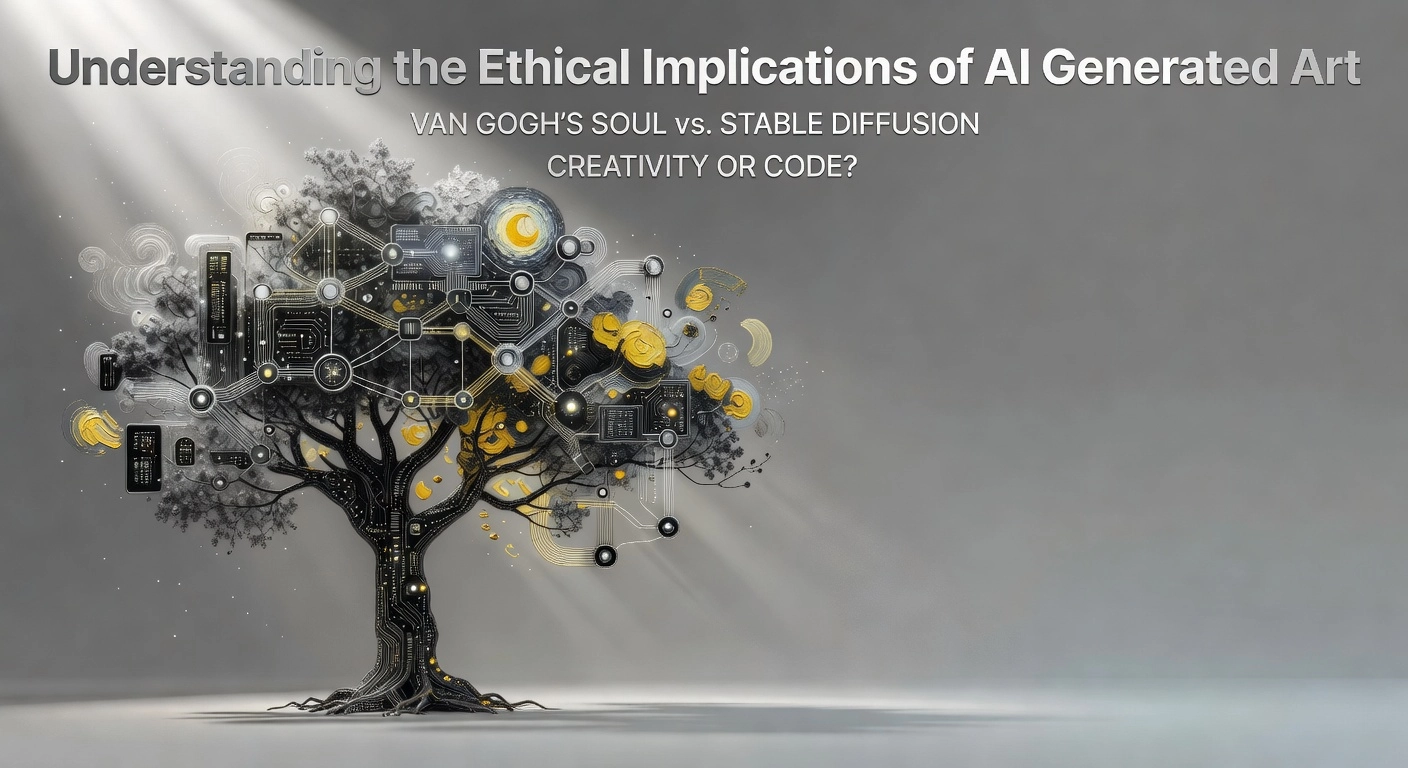
Imagine a masterpiece emerges on your screen in mere seconds: a surreal landscape rivaling Van Gogh, crafted not by human hands but by an algorithm trained on millions of artists’ works. This is the reality of AI generated art, captivating creators and collectors alike. Yet beneath the awe lies a storm of controversy. As tools like Stable Diffusion and Midjourney proliferate, they challenge fundamental notions of creativity, ownership, and value in the art world.
The ethics of ai generated art ethics demand scrutiny. Does scraping vast datasets of human art constitute theft? Who owns the output when machines remix copyrighted styles? And what of the livelihoods of artists displaced by instantaneous, low-cost alternatives? These questions are not abstract; they reshape industries and redefine artistry.
In this analysis, you will gain a clear understanding of the core ethical dilemmas, backed by real-world cases and expert perspectives. We examine intellectual property risks, bias in training data, transparency issues, and emerging regulations. By the end, you will be equipped to navigate the moral landscape of AI creativity with confidence, ready to advocate for a balanced future where innovation respects human ingenuity.
Ownership and Copyright Challenges
The U.S. Copyright Office’s 2023 rulings set a clear precedent in ai generated art ethics by denying protection for works produced solely by AI, such as the comic images in Zarya of the Dawn, where Midjourney generated visuals without sufficient human authorship. Subsequent decisions, including SURYAST and the 2025 Part 2 Report, affirmed that prompts alone do not qualify as creative control; human modifications must impart “expressive elements” for eligibility. Federal courts, in cases like Thaler v. Perlmutter, reinforced this by upholding that only human-authored content merits copyright. By 2026, lawsuits over AI clones, which mimic artists’ styles with hyper-realistic precision, have surged, as noted in BigNewsNetwork coverage, with over 60 cases by late 2025 signaling peak litigation risks for commercial outputs.
Ownership claims fracture among stakeholders: training data creators argue infringement from scraped datasets like LAION-5B, prompters assert tool-like authorship (dismissed by regulators), and developers invoke fair use, per Michigan Technological University’s ethical analysis. An AAAI survey of 459 artists reveals splits, with 41% favoring original artists, 39% users, and 27% developers owning outputs; 80% demand training data transparency. Michigan Tech urges opt-in consent and tools like Nightshade to protect datasets.
Visual artists face acute sales risks, as AI floods markets with cheap replicas, devaluing originals and prompting cease-and-desists, as explored in Creative AI Network’s blog Ethics in AI Art: Impacts and Implications. Platforms trained on unlicensed images exacerbate displacement, with 62% of artists in the AAAI study agreeing generative AI threatens livelihoods.
To mitigate, experts recommend hybrid human-AI attribution, disclosing AI roles in portfolios and using U.S. Copyright Office guidelines for verifiable human input. This fosters ethical innovation while safeguarding creators.
Data Sourcing and Infringement Risks
A primary ethical concern in ai generated art ethics stems from the training of generative models on vast datasets like LAION-5B, which comprises 5 to 5.8 billion images scraped from public websites without artists’ consent. This process, conducted by the nonprofit LAION, often ignores watermarks, ethical filters, and permissions, enabling widespread style theft. For instance, fantasy artist Greg Rutkowski’s distinctive style appears in roughly 93,000 Stable Diffusion prompts on platforms like Lexica, as reported by MIT Technology Review, overwhelming his authentic works online and diluting his commercial value. A University of Chicago initiative is countering this with tools to detect and prevent such “AI art heists,” underscoring academic alarm over unauthorized data extraction. Artists can check opt-out status via tools like “Have I Been Trained?,” though coverage remains spotty, leaving many vulnerable to privacy breaches.
In visual arts, these practices manifest in mimicked styles flooding exhibitions and markets, devaluing human labor. AI-generated pieces indistinguishable from human art still face audience devaluation, perceived as lacking emotional depth, with studies showing audiences prefer works with human involvement. Platforms like DeviantArt report AI boosting overall sales yet displacing creators, while galleries hosting AI exhibits, such as a 2025 Coeur d’Alene show, sparked protests over authenticity erosion. This oversaturation risks eroding art education funding and discouraging traditional skills, as 74% of artists view uncredited AI use as unethical.
Ongoing lawsuits amplify these risks, positioning ethical datasets as the future standard. Cases like Andersen v. Stability AI allege infringement through LAION-5B training, with outputs reproducing artists’ styles via novel “model” theories (Andersen v. Stability AI case analysis). Similarly, Getty Images v. Stability AI (UK, 2025) highlighted watermark misuse, while Disney sued Midjourney for copyright violations. Opt-out tools like Nightshade “poison” datasets, and 73% of artists demand pre-training consent. Rising settlements signal a shift to licensed data, as forecasted in 2026 litigation trends (AI lawsuits in 2026; AI copyright litigation paving way for licensing).
Public awareness grows, with 25-27% of Americans encountering AI art per ArtSmart.ai surveys, yet 70% believe artists deserve training data compensation, fueling infringement scrutiny. For AI enthusiasts, prioritizing transparent sourcing fosters sustainable creativity.
Authorship and Originality Debates
AI as Recombiner vs. Creator
Central to ai generated art ethics is the debate over whether AI functions as a mere recombiner of existing data or a genuine creator. Critics contend that AI lacks human agency, emotion, and intentionality, merely remixing patterns from training datasets to produce outputs that appear novel but lack true originality. A First Monday study interviewing 22 digital artists found that 62% view AI art as lacking artistic value, emphasizing its aesthetic impressiveness without the “soul” or iterative depth of human work. This perspective aligns with NC State research from January 2026, which identifies a tipping point: designers claim authorship only when AI input constitutes less than 50% of the process, beyond which perceived ownership and ethical well-being diminish. Proponents argue that human prompts and curation elevate AI to collaborative creation, democratizing access for non-experts. Actionable insight: artists should document their input levels to assert hybrid authorship credibly.
Disclosure Norms and Trust Preservation
To mitigate these concerns, disclosure norms are essential for maintaining trust in creative communities. CatCoq’s Ethical AI for Artists guidelines urge transparency, prohibiting the presentation of AI outputs as fully original in portfolios or sales, as this erodes confidence and invites misrepresentation claims. Treat AI as a supportive tool for inspiration, such as generating references, but always infuse personal style to ensure the final work reflects human authorship. By 2026, 30% of galleries have adopted similar policies, with 12 countries mandating labeling. Practitioners can implement this by watermarking AI-assisted pieces or noting tools used, fostering ethical hybrid workflows.
Studio Integration and Network Insights
The Creative AI Network‘s blog post, Exploring the Ethics of AI in Visual Arts, delves into studio applications, where single prompts can generate entire galleries, raising questions of efficiency versus human agency. It advocates balancing IP risks from biased training data with consent-based norms and hybrid practices. This resource offers professionals actionable frameworks for ethical classroom and studio use.
Philosophical Underpinnings
Philosophical views from ResearchGate publications, such as “Ethical and Philosophical Perspectives on Artificial Intelligence-Generated Art,” frame AI as operating on a spectrum from mimicry to potential hybrid innovation, yet fundamentally lacking self-awareness or motivation. These analyses challenge traditional notions of creativity, positing that while AI extends technological access, it complicates artistic integrity without human intent. Experts recommend redefining authorship through collaborative models to navigate this evolution.
Job Displacement and Accessibility Tensions
A core tension in ai generated art ethics lies in AI’s dual role: threatening professional artists’ livelihoods while democratizing creativity for newcomers. A survey presented at the AAAI/ACM Conference on AI, Ethics, and Society, involving 459 artists, revealed that 61.87% strongly agree generative AI endangers art workers, particularly in entry-level roles like book covers and animation, where tools replace human labor and unconsented data training exacerbates financial harm AAAI survey on artist livelihoods. Yet, 44.88% view AI positively for its democratization potential, enabling hobbyists, disabled creators, and those in underserved regions to explore visual arts through accessible prompting. This duality calls for transparency, with 80.17% demanding insight into training data to foster ethical balance.
Public perception reinforces human primacy. A Scientific American survey of 150 respondents found 81% discern greater emotional value in human-involved art, citing depth from personal experience that AI recombination lacks; 62% would value a favorite piece less if fully AI-generated Scientific American on emotional value in art. In visual arts, this fuels community backlash, as seen in Reddit’s r/ArtistLounge, which bans undisclosed AI to preserve authenticity amid detection failures that wrongly flag human work.
Balancing inclusivity demands safeguards. Non-professionals gain from AI’s low barriers, expanding markets via hybrid tools, but professionals face displacement without policies like mandated disclosure and fair compensation. Communities and platforms should enforce labeling, while creators adopt AI as augmenters, developing roles like prompt curation to protect livelihoods and amplify creativity. This ethical navigation ensures AI enhances, rather than erodes, human artistry.
Bias, Privacy, and Environmental Impacts
Biases in Training Data
Training datasets for AI-generated art, such as LAION-5B with its 5.85 billion images, often replicate societal biases, skewing visual outputs toward stereotypes. For instance, models frequently depict leadership roles with male figures and caregiving with females, while assigning lower professionalism scores to Black hairstyles compared to straightened white hair, as noted in Stanford research. A 2026 analysis reveals 83.1% of related AI models carry high bias risk, with only 13% of companies actively testing generative tools despite widespread detection capabilities. These distortions harm marginalized groups by perpetuating prejudices in art and media. To mitigate this, creators should prioritize diverse data curation, conduct regular audits, and monitor outputs, following expert advice from Lummi.ai’s ethics guide.
Privacy Breaches and Consent Issues
Privacy violations arise when personal images are scraped into datasets without consent, enabling unauthorized recreations like deepfakes. UNESCO’s 2021 Recommendation, updated through 2025, demands privacy by design, informed consent, and data erasure rights to protect biometrics and sensitive visuals. In February 2026, 61 global data protection authorities warned of risks including non-consensual intimate imagery from AI art generators. Artists and users face likeness theft in ads or media. Actionable steps include demanding opt-out mechanisms and transparency reports from model providers.
Environmental Toll and Sustainability
Compute-intensive models exact a heavy environmental price; training GPT-3 emitted 552,000-626,000 pounds of CO2, equivalent to 300 New York-San Francisco flights. By 2025, AI’s energy use hit 460 TWh, projected to double by 2026, with image generation consuming half a smartphone charge per inference. Water evaporation reached 700,000 liters for GPT-3 training alone. Sustainable practices demand efficient algorithms, renewable energy, and judicious use, as MIT experts advocate.
Broader AI Ethics Trends
These issues align with Forbes’ 2026 predictions on accountability, including bias audits, deepfake labeling, and global standards for trust in AI-generated art ethics. Creative AI Network urges community adoption of ethical tooling to balance innovation with responsibility.
Key 2026 Trends in AI Art Ethics
As 2026 unfolds, ai generated art ethics are shaped by intensifying legal battles, community responses, innovative tools, and evolving philosophical questions. With 65% of digital artists using AI tools daily and enterprise spending on AI art projected at $25 billion, the field demands balanced innovation and accountability.
Rising Lawsuits and Copyright Reforms for Agentic AI Guardrails
Lawsuits over AI training data have surged, with over 15 major cases building on 2023 filings like Getty Images v. Stability AI, alleging infringement from 2.5 million scraped images. Courts grapple with “transformative fair use,” while 2025 settlements, such as Anthropic’s $1.5 billion payout to authors, signal a shift toward licensing deals exceeding $500 million in claims. Reforms now target agentic AI guardrails, autonomous systems requiring human oversight and IP checks, as Forbes outlines in its 2026 ethics trends. Legislators propose autonomy thresholds and penalties to curb unauthorized outputs. Artists should advocate for opt-out mechanisms and revenue-sharing models to protect livelihoods.
Community Adaptations: Art Education Trends and Bans on Undisclosed AI
Art education emphasizes “productive difficulty,” prioritizing human process over AI polish, per University of Florida’s School of Art + Art History. Curricula now integrate AI only after conceptual development, with 72% of students exposed yet facing detector stress. Communities enforce bans, like San Diego Comic-Con’s 2026 prohibition on undisclosed AI art; 30% of galleries adopt disclosure rules, and 62% of consumers value less for labeled AI works, per AI art statistics. Professionals can adapt by transparently labeling portfolios.
Ethical Tooling and Events like AI + Ethics: Exploring Critical Agency
Tools now mandate watermarks, bias audits, and explainable AI to fight deepfakes. The Cleveland Institute of Art’s 2025 event explored critical agency, influencing governance codes for creative pipelines.
Philosophical Shifts in Creativity Debates
ResearchGate papers highlight “Machine Kitsch Theory,” challenging AI as recombiner versus creator; 81% prefer human-involved art for emotional depth. Global standards may harmonize authorship views, urging ethical frameworks that elevate human agency.
Guidelines for Ethical AI Art Creation
Using Consented Datasets and Tools with Transparency Features
Prioritize AI tools trained on consented datasets to sidestep infringement risks highlighted in ongoing lawsuits. For instance, 78% of AI art models rely on unlicensed data, per recent analyses, fueling demands for opt-in mechanisms. Select platforms offering provenance tracking and model logging, such as those endorsed by industry guidelines. Actionable step: Audit your toolkit by checking for whitelisted data sources and bias reports before generation. This approach not only respects artist rights but aligns with EU AI Act classifications for high-risk systems. Creative AI Network resources provide checklists to verify tool ethics, ensuring your practice contributes to sustainable innovation.
Mandating AI Disclosure in Portfolios and Exhibitions
Transparency remains essential for upholding visual arts integrity amid rising bans on undisclosed AI. Platforms now require labels like “CreatedWithAI,” as seen in Comic-Con’s 2026 rules update, prohibiting pure AI entries. Disclose AI involvement in portfolios, exhibitions, and client pitches; only 31% currently do so consistently, despite 65% public opposition to unlabeled works. Italy’s Law No. 132/2025 mandates human input documentation for copyright eligibility. Implement clear tagging and inform buyers upfront to build trust. Such practices prevent devaluation, with 62% of consumers willing to pay less for undisclosed AI art.
Promoting Hybrid Workflows
Embrace hybrid human-AI workflows to amplify creativity, where AI handles repetition and humans drive originality. With 65% of digital artists using AI daily, per Envato’s AI trend report, roles like AI Creative Director emerge. Join Creative AI Network’s LinkedIn group for discussions on iteration trees and case studies, or attend London meetups like prompt-to-prototype labs. These events foster connections between artists and practitioners, offering rate cards and templates. Hybrid methods mitigate 70% artist fears of job loss while enhancing output quality.
Prompting Checklists and Bias Audits
Combat biases through structured prompting and regular audits, addressing the 85% prevalence in models. Develop checklists specifying diverse representations, version control, and stereotype avoidance; test outputs for cultural skews via human review. Creative AI Network fills gaps with free bias testing tools and prompt libraries. Retain final control, as 75% AI detectors yield false positives. These steps ensure equitable art, supporting community standards amid 90% synthetic content projections by 2026.
Actionable Takeaways for Visual AI Creators
Prioritize Human Oversight
Integrate substantial human input into your AI workflows to amplify emotional resonance in ai generated art ethics. A Scientific American survey reveals 81% of respondents prefer art with human involvement for its perceived emotional value. Actionably, refine AI outputs through iterative sketching, color adjustments, and narrative layering, as seen in hybrid practices where artists like Refik Anadol blend prompts with manual edits. This not only elevates quality but aligns with U.S. Copyright Office rulings requiring human authorship for protection.
Transparent Disclosure and Community Engagement
Always disclose AI usage in metadata, portfolios, and sales to foster trust and preempt legal pitfalls. Emerging laws, including EU AI Act provisions, mandate transparency for high-risk applications. Join Creative AI Network events and polls on LinkedIn to debate these issues, drawing from their posts like “Ethics in AI Art: Impacts and Implications.”
Ethical Datasets and Sustainability
Champion tools with consented datasets, avoiding infringement-prone models like those using LAION-5B. Prioritize sustainability by selecting low-compute options, reducing environmental strain from training.
Stay Ahead of 2026 Legal Shifts
Track 2026 updates on copyright reform and style mimicry lawsuits to safeguard your ownership rights, ensuring proactive portfolio strategies.
Conclusion
In summary, AI generated art raises profound ethical concerns, including the theft-like scraping of human artworks for training data, murky ownership of remixed outputs, displacement of artists’ livelihoods, and biases perpetuated through flawed datasets. These issues demand urgent attention to protect creativity and fairness.
This post delivers clear insights, grounded in real-world cases and expert perspectives, empowering you to grasp the stakes and implications.
Take action now: advocate for robust IP laws, support artists through ethical platforms, and demand transparency from AI developers. By championing balanced innovation, we can harness AI’s potential while preserving the soul of human artistry, inspiring a future where technology elevates, not erodes, creative expression.
No responses yet