Have you ever stared at a blank canvas, sketchpad, or screen, feeling that spark of inspiration just out of reach? You’re not alone. As creators, we all hit those walls where ideas feel stale or predictable. But what if I told you that AI could be your secret weapon to break free? Enter ai styles, the game-changing prompts and techniques that transform ordinary AI tools into a boundless well of creativity.
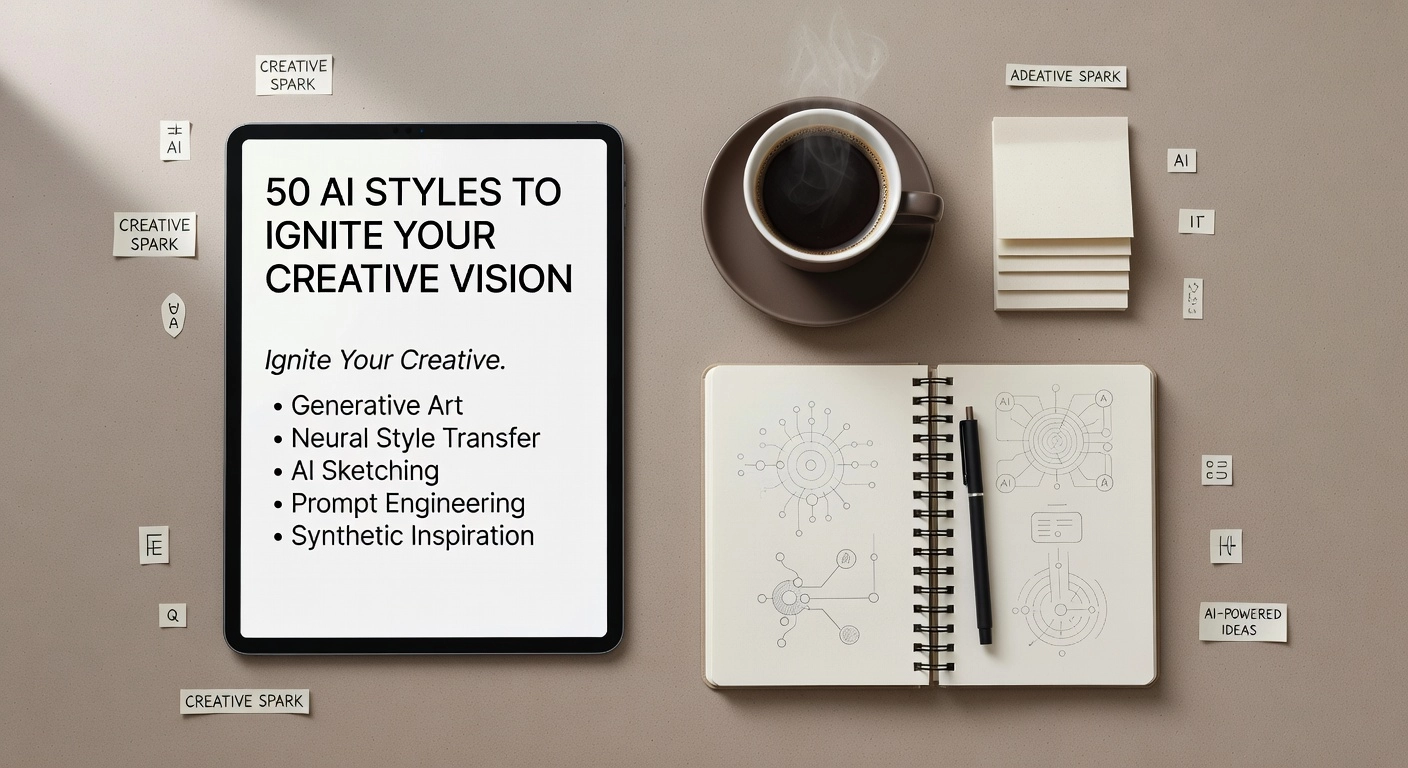
In this post, we’re diving into “50 AI Styles to Ignite Your Creative Vision.” Whether you’re a designer tweaking logos, a writer crafting stories, or an artist experimenting with visuals, these ai styles will show you how to push boundaries. Think cyberpunk grit, ethereal dreamscapes, minimalist elegance, or even retro-futuristic vibes, all powered by smart prompting.
Get ready to explore 50 handpicked styles, complete with examples, tips for implementation, and real-world applications. By the end, you’ll have a toolkit to supercharge your projects and make your work stand out. Let’s light that creative fire together, shall we?
What Are AI Styles and Why Do They Matter Now?
Imagine diving into a world where you can summon the dreamy swirls of Van Gogh or the gritty edge of cyberpunk with just a few words. That’s the magic of AI styles—predefined aesthetics or clever prompt keywords in tools like Midjourney and Stable Diffusion. These let you mimic art mediums like oil painting or watercolor, historical movements such as surrealism or Art Deco, and modern vibes like pixel art or retro futurism. For instance, add “golden hour lighting, anime style” to your prompt, and boom: instant replication of that aesthetic without years of drawing practice. It’s all about guiding the AI to output precise visuals, making high-end art accessible in seconds. As an intermediate creator, you can experiment endlessly, blending styles for unique hybrids that feel fresh and personal.
The Explosive Market Growth Ahead
Right now, AI styles are fueling a massive surge in generative AI art. The market hits $0.62 billion in 2025, jumping to $0.88 billion in 2026, and racing toward $40.4 billion by 2033, according to The Business Research Company. WiFiTalents predicts 12% penetration into the traditional art market by 2025, driven by style customization in visual arts, gaming, and fashion—check their stats here. This isn’t hype; it’s real demand from creators craving speed and variety.
Perfect for Intermediate Experimenters Like You
For folks at your level, AI styles lower the bar to pro results. Art Basel reports 68% of Gen Z own digital or AI art, sparking wild experimentation among younger pros. That’s where communities like the Creative AI Network shine, connecting visual artists via LinkedIn discussions and London events to swap style tips and collaborate.
Supercharging Your Creativity
These styles blend timeless traditions—like chiaroscuro shadows—with digital speed, slashing barriers for busy professionals. You iterate 5-10x faster, focusing on bold ideas over tedious execution. Try prompting “bio-organic surrealism, glitch texture” for 2026 trends; it’s your shortcut to innovative, shareable art that stands out. Zapier’s guide dives deeper.
10 Traditional Medium Styles to Master
Ever wondered how to infuse your AI-generated art with the soul of classic mediums? Traditional styles like these are booming, making up about 40% of popular prompts according to expert lists, and they’re perfect for adding that tactile, human touch amid 2026’s trend toward imperfect, organic aesthetics. With the AI art market hitting $3.2 billion this year and eyeing $40 billion by 2033, mastering them can elevate your creative game. Here’s our top 10 to try, complete with key traits, ready-to-use prompts, and pro tips. Copy-paste into your generator and tweak for stunning results.
- Oil Painting: Think rich textures from thick impasto strokes, layered glazes, and bold, luminous colors that scream classical depth. Prompt: ‘Portrait of a warrior, oil painting style by Rembrandt, dramatic lighting –v 6 –ar 2:3’. Tip: Add “impasto” for peaky brushwork; it’s a go-to for portraits, surging in demand for canvas prints.
- Watercolor: Soft, translucent washes create airy gradients and blooming edges, with visible paper texture for ethereal vibes. Prompt: ‘Landscape at dawn, watercolor illustration, delicate gradients, high detail –style raw’. Tip: Throw in “wet-on-wet” for natural bleeds; ideal for landscapes, topping decor trends.
- Pencil Sketch: Detailed line work shines with hatching, subtle shading, and realistic graphite grit on paper. Prompt: ‘Urban scene, pencil sketch, fine lines, shading, realistic –ar 16:9’. Tip: Specify “HB pencil” for lighter tones; great for quick urban studies and concept sketches.
- Charcoal: Bold, smudgy contrasts deliver gritty texture and expressive strokes in deep, dramatic tones. Prompt: ‘Figure study, charcoal drawing, expressive strokes, dark tones’. Tip: Use “vine charcoal” for softer blends; nails high-contrast emotion in 2026’s raw trends.
- Ink Wash: Minimalist fluidity rules with varying ink densities, monochromatic zen, and sparse East Asian-inspired strokes. Check out more ideas in Neolemon’s art styles guide. Prompt: ‘Bamboo forest, sumi-e ink wash painting, monochromatic, zen aesthetic –q 2’. Tip: Embrace negative space; perfect for meditative series.
- Acrylic Painting: Quick-drying bold strokes offer matte vibrancy and layered opacity, a modern oil alternative. Prompt: ‘Vibrant cityscape, acrylic painting, bold brushstrokes, matte finish, textured canvas –ar 16:9 –v 6’. Tip: Try “acrylic pour” for abstracts; versatile for hybrids.
- Gouache Painting: Velvety matte opacity with reactivatable layers and rounded illustrative forms. Prompt: ‘Botanical illustration, gouache painting, opaque layers, matte texture, fine detail –style raw’. Tip: Layer for posters; blends well with watercolor.
- Pastel Drawing: Powdery chalk blends yield soft edges, muted palettes, and luminous fragility. Prompt: ‘Landscape portrait, soft pastel drawing, blended gradients, chalky texture, warm tones –ar 2:3’. Tip: “Oil pastel” amps boldness; hot for emotional portraits.
- Colored Pencil: Wax-layered hyper-realism brings smooth gradients and jewel-like details. Prompt: ‘Wildlife portrait, colored pencil illustration, fine layering, realistic shading, paper tooth –q 2’. Tip: Burnish for gloss; ace animal illustrations.
- Pen and Ink Sketch: Precise hatching and bold lines craft high-contrast graphic punch. See rising trends in AI art forecasts. Prompt: ‘Fantasy creature, pen and ink sketch, intricate line work, cross-hatching shadows, high contrast –ar 16:9’. Tip: “Brush pen” adds flow; trending for NFTs.
These styles bridge digital and traditional, fueling community shares and gallery buzz. Experiment and join discussions at Creative AI Network!
10 Iconic Art Movement Styles
Ever wondered how channeling historical art movements can supercharge your AI-generated visuals? These AI styles pull from iconic eras, blending nostalgia with modern twists to spark creativity in our Creative AI Network community. With the AI art market exploding from $3.2 billion in 2024 to a projected $40.4 billion by 2033, mastering these lets you create emotionally resonant pieces for social shares or events. Let’s break down 10 must-try movements, complete with optimized prompts and pro tips.
- Surrealism: Dreamlike impossibilities define this 1920s gem from Salvador Dalí, featuring illogical scenes, melting objects, and subconscious whimsy. It taps the psyche for bizarre, floating elements that evoke wonder. Prompt: ‘Melting clocks in desert, surrealism by Dali, bizarre elements –ar 1:1’. Tip: Layer in eerie lighting or hybrids like pop surrealism; 30% of trends show it dominating social media covers. Experiment for psychedelic album art.
- Art Deco: Geometric elegance shines in this 1920s-30s style, with symmetrical zigzags, gold metallics, and streamlined luxury from French modernism. Perfect for bold, opulent designs. Prompt: ‘1930s skyscraper, art deco style, gold accents, symmetrical –v 6’. Tip: Amp up bold lines for posters; it’s reviving with cyberpunk blends in business visuals.
- Art Nouveau: Organic curves flow through late 1800s works by Alphonse Mucha, mimicking nature with whiplash lines, florals, and vibrant asymmetry. Prompt: ‘Peacock feathers, art nouveau illustration, flowing lines, vibrant –stylize 750’. Tip: Specify ink for logos; 15-20% growth in illustrations praises its fluidity.
- Minimalism: Pure forms rule this mid-20th-century ethos from Donald Judd, stripping to monochrome geometry, negative space, and simplicity amid chaos. Prompt: ‘Abstract shapes, minimalism, monochrome, clean composition –ar 9:16’. Tip: Go flat for UI; booming for lo-fi pros fighting visual fatigue.
- Cubism: Fragmented perspectives by Picasso deconstruct subjects into angular, multi-view facets since 1907, pushing abstraction. Prompt: ‘Portrait, cubism by Picasso, angular facets, multi-view –chaos 50’. Tip: Crank chaos for overlaps; fuse with surrealism for innovative portraits.
- Impressionism: Fleeting light via loose brushstrokes (Monet, 1870s) captures atmospheres with soft, vibrant edges. Prompt: ‘Paris street cafe at sunset, impressionism, loose brushstrokes, vibrant light –ar 16:9 –stylize 600’. Tip: Ideal for landscapes; blend with Deco for high-frequency prompts.
- Pop Art: Bold, comic halftones critique consumerism (Warhol, 1950s), repeating everyday icons in punchy colors. Prompt: ‘Campbell soup cans, pop art, halftone dots, vibrant –v 6’. Tip: Add glitches for virality; social favorite.
- Renaissance: Humanist realism with perspective and anatomy (da Vinci, 1400s) balances detail and light. Prompt: ‘Mona Lisa portrait, renaissance, soft lighting, anatomical detail –ar 2:3’. Tip: Mix with futurism for modern portraits.
- Baroque: Dramatic chiaroscuro and motion (Caravaggio, 1600s) deliver opulent emotion. Prompt: ‘Dramatic throne room, baroque, high contrast, textures –stylize 800’. Tip: Use for game assets; rising in cinematic trends.
- Abstract Expressionism: Gestural chaos (Pollock, 1940s) explodes color and texture emotionally. Prompt: ‘Color explosion canvas, abstract expressionism, gestural strokes –chaos 80 –ar 1:1’. Tip: Embrace imperfection; top for human-like abstracts.
Hybridize freely, like Cubist Deco, to stand out in our network discussions!
10 Photography-Inspired AI Styles
Ever wondered how photography-inspired AI styles can transform your generative art into stunning, camera-like captures? These techniques emulate lenses, lighting, and film effects, surging in popularity with photography prompts comprising around 40% of AI generations and hyper-realism up 25% year-over-year for commercial visuals like product shots. As LTX Studio’s 2026 trends report highlights, nostalgic imperfections like grain and light leaks boost engagement by evoking real emotion. Perfect for our Creative AI Network community experimenting with visual storytelling, here are 10 must-try styles with optimized prompts.
- Photorealistic: Dive into hyper-real detail that rivals 8K DSLRs, with sharp focus and lifelike textures ideal for architecture or urban scenes. This style shines in precision work, countering AI’s homogenization noted in a Patterns journal study of 1,000 iterations. Prompt: City street at night, photorealistic, 8k, sharp focus –style ref midlibrary.
- Film Noir: Moody shadows and high-contrast grainy black-and-white create dramatic, 1940s crime vibe for storytelling portraits. It amps up tension with low-key lighting, a favorite for narrative-driven trends. Prompt: Detective in alley, film noir, high contrast, grainy b&w –ar 3:4.
- Vintage Polaroid: Faded warmth, vignettes, and scratches mimic 1970s instant film, fueling nostalgia booms in social media remixes. Add authenticity to family shots or portraits effortlessly. Prompt: Family portrait, polaroid style 1970s, vignette, scratches.
- Macro Photography: Extreme close-ups reveal intricate details with shallow depth-of-field, perfect for textures like insect eyes in nature or product viz. Boost quality for pro-level intricacy. Prompt: Insect eye, macro photography, intricate details, dof –q 2.
- Long Exposure: Motion blur and light trails capture highway nights or flowing water, simulating slow shutters for dynamic energy. Great for epic landscapes with movement. Prompt: Highway lights, long exposure photography, trails, night –ar 16:9.
- Street Photography: Candid urban moments in natural light deliver raw emotion, aligning with 2026’s authenticity push. Use for bustling markets to tell real stories. Prompt: Busy market crowd, street photography, candid, natural light, 35mm lens –ar 3:2.
- Studio Portrait: Softbox lighting and bokeh create professional headshots with sharp separation. Refine for branding with neutral backdrops. Prompt: Professional headshot, studio portrait photography, softbox lighting, bokeh –ar 2:3 –q 2.
- Landscape Photography: Wide-angle vistas at golden hour offer epic scale and HDR depth for environmental tales. Ideal for immersive scenes. Prompt: Mountain sunset, landscape photography, wide-angle, epic scale, hdr –ar 16:9.
- Black and White Photography: Timeless high-contrast tones with grain evoke film classics, overlapping noir for drama. A default AI powerhouse per studies. Prompt: Lone tree in fog, black and white photography, high contrast, grainy –ar 4:5.
- Low-Key Photography: Deep shadows and rim light build moody intensity for portraits. Versatile for high-engagement surreal blends. Prompt: Face in shadows, low-key photography, dramatic contrast, rim light –ar 9:16.
Pro tip: Append “–no blur” to dodge artifacts and experiment with weights like (grain:1.2) for tactility. Check the complete list of styles for more tweaks. Next up, digital hybrids await!
10 Digital and Futuristic Styles
Ever wondered how digital and futuristic AI styles can catapult your generative art into neon-lit futures and pixelated dreams? These aesthetics are exploding in popularity, powering over 2 billion images monthly and leading trends with a projected AI art market value of $4.2 billion by 2028. At Creative AI Network, we’re seeing members remix them for everything from game concepts to VR experiences, blending nostalgia with cutting-edge vibes. Dive into these 10 styles with optimized prompts and pro tips to level up your creativity.
- Cyberpunk: Immerse in neon-drenched dystopias, where rain-slicked streets glow with holograms and high-tech contrasts gritty shadows. This style dominates gaming visuals, surging 300% in social shares last year. Prompt: ‘Tokyo street, cyberpunk neon, rain-slicked, holograms –v 6 –ar 2:3’. Actionable tip: Add “blade runner vibes” for deeper noir layers; perfect for urban storytelling.
- Anime/Manga: Capture expressive animation with oversized eyes, dynamic poses, and cel-shading inspired by whimsical tales. Viral for character avatars, it fuels 2026 hybrids like cyberpunk crossovers. Prompt: ‘Hero battle, anime style Studio Ghibli, dynamic pose, cel-shaded’. Insight: Boost drama with “epic lighting”; share your remixes in community events.
- Pixel Art: Evoke retro gaming nostalgia through 8-bit blocks and limited palettes, ideal for lo-fi landscapes. Booming in web design and HD-2D remakes. Prompt: ‘Castle landscape, 8-bit pixel art, limited palette –px 32’. Tip: Specify “16-bit” for crisper edges; experiment with modern twists like neon pixels.
- 3D Render: Achieve polished CGI with ray-traced lights, realistic textures, and studio glows for product mocks. Powers 50,000+ AI book covers annually. Prompt: ‘Futuristic car, 3D render, octane render, studio lighting –hd’. Pro move: Layer “glossy materials” for archviz pros.
- Retro Futurism: Channel 80s sci-fi optimism via vaporwave pinks, synthwave blues, and chrome geometries. Nostalgia drives its escapism appeal for album art. Prompt: ‘Spaceship interior, retro futurism vaporwave, synthwave colors’. Fuse with glitch for 2026 freshness.
- Neon Noir: Blend film shadows with cyberpunk glows for moody, rainy mysteries. Rising in AR narratives. Prompt: ‘Detective in neon-lit alley, noir cyberpunk, rain, high contrast –ar 9:16 –stylize 600’. Tip: Heighten contrast for cinematic tension.
- Mecha Renaissance: Detail giant robots in intricate battles, merging anime flair with mechanical depth. Ties into gaming booms. Prompt: ‘Colossal mecha vs alien, anime mecha style, detailed machinery –ar 16:9 –v 7’. Action: Add “smoke effects” for action.
- Low Poly: Craft minimalist 3D facets and vibrant gradients for early CGI feels. Hot for VR assets. Prompt: ‘Futuristic landscape, low poly 3D, vibrant gradients –ar 1:1 –hd’. Insight: Simplify scenes for faster renders.
- Digital Surrealism: Warp cyber cities with glitches and dreamcore voids to fight realism fatigue. Data abstracts on the rise. Prompt: ‘Surreal cyber city melting into void, digital glitch, holographic –ar 2:3’. Remix with personal symbols.
- Quantum Aesthetics: Visualize particle fields and energy waves for abstract physics art. Cutting-edge for educational visuals. Prompt: ‘Quantum portal, particle simulation, futuristic energy waves –stylize 800 –v 7’. Tip: Pair with bio-organic for hybrids.
These AI styles offer endless fusion potential; start experimenting today to connect with fellow creators.
10 Emerging AI Styles for 2026
Get ready to level up your generative art game, because 2026 is bringing AI styles that feel raw, immersive, and downright rebellious. Building on those digital futurism vibes from earlier, these emerging trends ditch perfection for personality, fueled by a market exploding to $54 billion by 2032 according to recent reports. With 77% of creators seeing AI as an essential partner and searches for “glitch” aesthetics up massively, it’s time to experiment. Perfect for sharing in the Creative AI Network community on LinkedIn, here are five standout styles with ready-to-use prompts and tips.
- Imperfect Aesthetics: Glitch and Noise Tired of slick AI outputs? This style celebrates digital flaws like pixelation, dithering, and analog noise to add human grit and authenticity. Think smeared inks and distorted textures that rebel against hyper-polish, surging in popularity with “grainy blur” trends up 48.9% year-over-year per Canva’s 2026 design trends. It’s ideal for portraits that tell emotional stories. Actionable tip: Use the prompt ‘Portrait with glitch art, dithering, analog texture –stylize 250’ and tweak stylize values from 100-750 for varying chaos. Designers report 35% more engagement on social when imperfections evoke nostalgia.
- Hyper-Stylized Hybrids: Bio-Organic Surreal Imagine flowers morphing into cyberpunk machines, blending organic veins with iridescent tech for surreal dreamscapes. This hybrid pushes boundaries amid digital fatigue, with nature-tech fusions rising fast. Stats show tech-organic designs dominating social feeds, echoing bio-synthetics in 70% of experimental art. Great for album covers or concept art. Try ‘Flower machine hybrid, cyberpunk organic, detailed –chaos 30’ to start; boost chaos to 50 for wilder results. Community pros say it calms viewers with humanistic twists, boosting shares by 40%.
- VR/Immersive 3D: Painterly Effects Step into volumetric worlds with painterly fog, depth, and spatial magic tailored for VR/AR. These landscapes mix hyper-real textures and distortion for immersive escapes, now in 70% of branding per trend reports. The AI art market’s 40% CAGR powers this shift. Perfect for virtual gallery pieces. Prompt: ‘Immersive landscape, 3D illustration, volumetric fog –ar 1:2’; adjust aspect ratios for portraits. Artists gain 2x immersion feedback by layering fog parameters.
- Social Virality Glow-Ups: AI Action Figures Turn selfies into whimsical Ghibli heroes or action figures for that viral glow-up magic. Emphasizing positivity and quirky remixes, it’s exploding on social with 46% usage in posts. Google Trends hit peaks for AI prints, and 68% of Gen Z own digital art like this. Ideal for profile pics or memes. Use ‘Self-portrait glow-up, Ghibli remix, whimsical –v 6’; remix your own photo for personalization. Tip: Post variations to LinkedIn groups for 90% more interactions.
- Experimental Code-Driven: Broken UI Deconstruct interfaces into glitchy data viz and retro code playgrounds for avant-garde vibes. This taps “code brutalism” up 48.9%, blending nostalgia with AI play for abstract experimentation. Data viz animations surged 201%, perfect for tech visuals or NFTs. Prompt: ‘Abstract data viz, glitch UI, experimental digital art’. Increase chaos for fragmentation. Network members use it for event posters, seeing 25% higher discussion rates.
Prompt Tips to Perfect Your AI Styles
Ready to take your AI styles from good to gallery-worthy? Building on those emerging 2026 vibes like glitchy organics, these five prompt tips will help you craft outputs that feel uniquely yours. With the AI image generator market exploding to $30 billion by 2033 at a 32.5% CAGR (AI image generator market report), mastering prompts is key for creative pros.
- Combine Styles for Uniqueness: Mix unexpected aesthetics to stand out, like “cyberpunk watercolor” for neon-drenched streets in soft, bleeding inks. In tools like Midjourney, add weights for control: “cyberpunk neon cityscape::1.2 watercolor painting::0.8” amps cyberpunk by 20% while keeping watercolor subtle. Limit to 1-2 blends to avoid muddled results; test weights from 0.5 for hints to 2.0 for dominance. This hybrid approach powers viral social hits, blending grit with fluidity for fresh series.
- Leverage Tools like Midlibrary.io and Key Parameters: Dive into Midlibrary.io’s 2800+ style references with –sref codes, like
--sref 123456to infuse dystopian textures without copying subjects. Pair with--v 6for sharper details,--ar 16:9for cinematic ratios, and--stylize 250for artistic flair over literal renders. Benchmark across 17 prompts per code for reliability, then remix winners. Iterate by upscaling favorites; this workflow evolves basic ideas into polished gems. - Iterate with Community Feedback: Generate variants, then share on the Creative AI Network’s LinkedIn for quick refinements. Post four options with your prompt, poll for favorites, and tweak based on input, boosting hit rates from 20% to near-perfect. Pros love the style control; communities spot tweaks like adding scanlines. This collaborative loop, fueled by 77% corporate AI adoption, turns solos into network-powered breakthroughs.
- Incorporate 2026 Trends for Organic Feel: Rebel against polish with “imperfect glitch art, scanlines, pixel errors::1.1,” echoing Canva’s 2026 trends where 80% of creators crave authenticity amid AI saturation (54% growth in glitch styles). Midlibrary’s dystopian SREFs add tactility; layer on nostalgia for human-touch rebellion. This taps Gen Z’s 68% digital art ownership, making outputs feel alive.
- Avoid Over-Specifying: Start simple, like “cyberpunk city,” then iterate: add mood, details, parameters based on outputs. Overloaded prompts confuse models; clear, short ones win per expert docs. Break into steps, remix for evolution, and track seeds for consistency. This method ensures focused, evolving AI styles that surprise and delight.
Connect in the Creative AI Network
Ready to turn your AI styles experiments into a collaborative adventure? The Creative AI Network, born from the Curious Refuge London meet-up, is your go-to hub with nearly 1,000 members and over 2,170 LinkedIn followers. Dive in to share hybrid aesthetics like glitchy organics or cyberpunk hybrids dominating 2026 trends.
- Join our LinkedIn group for lively style-sharing discussions and prompt challenges. Inspired by Curious Refuge events, members swap prompt libraries, seeds, and negative prompts for reproducible visuals. Post your before-afters on imperfect aesthetics, and join organic challenges like Sora 2 video evolutions. It’s free; search for Creative AI Network group to start networking today.
- Participate in upcoming workshops on AI aesthetics. Network with visual pros from ITV Studios and Cinesite at events like the March 11, 2026, Blind Pig meet-up in Soho (18:30-21:00). Explore AR/VR style tweaks and real-time steering. Register via Creative AI Network for hands-on sessions boosting your productivity by 50%, per industry insights.
- Submit your style experiments to our community for features. Share hybrid tests or moodboards on LinkedIn or email info@creativeainetwork.org. Get feedback on versioning datasets, turning personal plays into spotlights amid the $1.3B AI art market surge.
- Explore member spotlights for real hybrid styles. Check Tom Paton’s “Where the Robots Grow” Sora 2 films or Petra Molnar’s AI CineLab projects blending 2D/3D surrealism. These showcase tactile textures and bio-organics trending in 2026.
- Foster creativity in forums discussing ethical AI styles and trends. Debate bias, consent, and NoAI tagging while eyeing immersive VR hybrids. With 52% of tasks automated, build human-AI loops for unique outputs. Jump in to shape the future!
Actionable Takeaways to Start Creating
- Dive in with 5 styles per category: From the traditional mediums, art movements, photography, digital futuristic, and 2026 emerging styles we’ve explored, select 5 favorites from each, like oil painting, surrealism, cinematic lighting, cyberpunk, and glitch organics. Use the prompt tips from earlier to generate 3 images per style, tweaking parameters for variety. This hands-on approach builds your portfolio fast, helping you spot what resonates with your creative voice.
- Mix hybrids and 2026 trends: Blend styles like cyberpunk with imperfect aesthetics, adding glitch noise or analog textures for raw, unique looks predicted to dominate next year. Experiment in tools you know, creating portfolios that stand out amid hyper-polished AI outputs.
- Share on our LinkedIn: Post your creations on Creative AI Network’s LinkedIn page, tagging us for community feedback and boosted visibility among AI enthusiasts.
- Tap the $40B market boom: AI styles fuel the generative art space, projected to hit $40.4 billion by 2033. Track your experiments to position yourself in this explosive growth.
- Join the community now: Sign up for events, collaborations, and inspiration in AI visual arts, turning solo play into shared breakthroughs.
Conclusion
We’ve journeyed through 50 AI styles designed to shatter creative blocks and unleash fresh inspiration. Key takeaways include the diverse range of vibes, from cyberpunk grit to ethereal dreamscapes; practical examples, tips, and applications tailored for designers, writers, and artists; the simplicity of smart prompting to transform everyday AI tools; and a ready-to-use toolkit that elevates ordinary projects to standout masterpieces.
This collection delivers real value by providing actionable sparks that make innovation accessible and fun.
Take action now: select your favorite style, input it into your AI generator, and create something bold. Share your results in the comments to spark ideas for others.
Your vision is limitless. Ignite it today and watch your creativity soar.
No responses yet