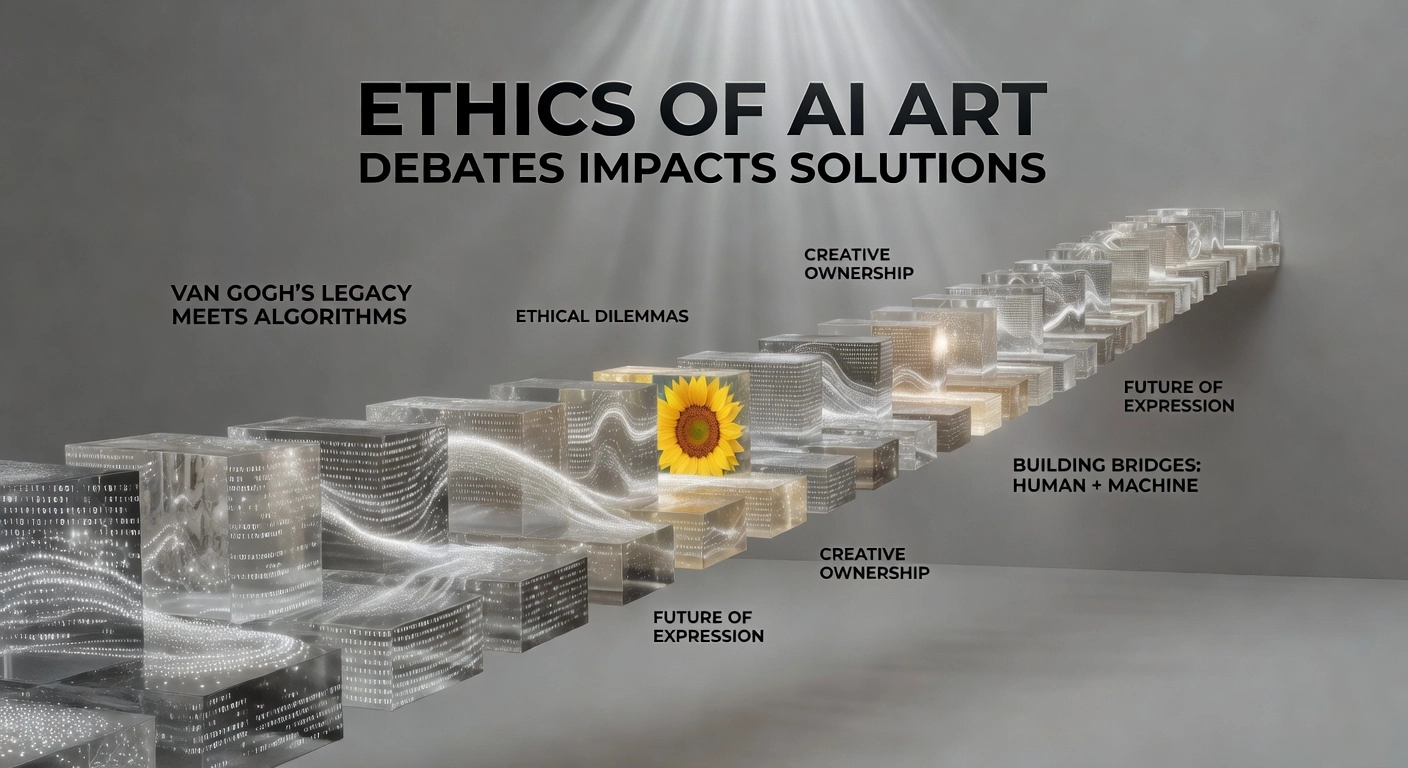
Imagine a world where a machine conjures masterpieces in seconds, mimicking the brushstrokes of Van Gogh or the surreal visions of Dali with eerie precision. This is no longer science fiction. Tools like DALL-E and Midjourney have democratized art creation, sparking fierce debates on the ethics of AI art. Creators, collectors, and critics alike grapple with profound questions: Does AI truly create, or merely remix human ingenuity? Who owns the soul of a generated image born from scraped datasets of countless artists’ works?
As AI art proliferates across galleries, stock images, and social media, its ethical implications demand scrutiny. This analysis delves into the core debates surrounding authorship, intellectual property, and authenticity. We examine the tangible impacts on human artists, from job displacement to cultural dilution. Finally, we explore pragmatic solutions, including regulatory frameworks, transparent training data practices, and hybrid human-AI collaborations that honor creativity’s human essence.
Whether you are an artist navigating these tools, a policymaker shaping the future, or a curious observer, this post equips you with the insights to engage thoughtfully in the conversation. The ethics of AI art is not just a philosophical puzzle. It is a pivotal challenge defining the boundary between innovation and imitation in our digital age.
Copyright and Training Data Controversies
Training on Internet-Scraped Datasets Without Consent
Generative AI models powering much of today’s AI art rely on vast datasets scraped from the internet, such as LAION-5B, which aggregates billions of images without artists’ explicit permission. This practice raises core ethical issues in the ethics of AI art, as creators receive no compensation or notification while their styles and works fuel commercial tools. According to a 2026 artsmart.ai survey, 74 percent of artists and users view this unauthorized use as a major contention point, underscoring widespread frustration with opaque data sourcing. Such exploitation not only infringes on intellectual property but also perpetuates biases embedded in uncurated web content. As synthetic data rises—projected by Gartner to comprise 75 percent of training inputs in 2026—this shift may lessen future scraping, yet it fails to address historical grievances or the need for diverse, high-quality human art.
The Prize-Winning AI Image Controversy
A pivotal moment came in 2022 when Jason Allen’s Midjourney-generated “Théâtre D’opéra Spatial” claimed first prize at the Colorado State Fair’s digital art category, igniting fierce debates on ownership and creativity. Artists decried it as unfair competition, arguing that AI outputs derive value from training on human works without attribution. The Michigan Technological University (MTU) blog “Binary Ballet: Toeing the Line of Ethics in AI Art” dissects this case, highlighting challenges in tracing influences and advocating for clearer authorship rules. Creative AI Network’s prior coverage of award-winning AI pieces echoes these concerns, emphasizing how such victories blur lines between human ingenuity and machine mimicry. U.S. courts have since ruled AI-generated art ineligible for copyright absent substantial human input, setting precedents that demand transparency.
Lawsuits and Academic Analysis
Litigation against AI firms has exploded, with over 80 U.S. cases by early 2026 alleging infringement via unauthorized training data. High-profile suits, like artists versus Stability AI and Getty Images versus Stability, test fair use defenses amid settlements exceeding $1.5 billion. Academic scrutiny abounds, with over 40 papers from 2024-2026 on granthaalayahpublication.org exploring litigation’s ramifications for visual arts ethics. These studies predict a 2026 peak in filings, shifting focus to AI outputs. As noted in recent Forbes analysis, creators must pursue licensing now to avoid obsolescence.
Artist Protection Tools and Community Implications
Tools like Glaze and Nightshade empower artists: Glaze subtly alters images to foil style extraction, while Nightshade “poisons” data by embedding misleading associations, both from University of Chicago researchers. Artists should apply these pre-upload, pairing with metadata for robust defense in an arms race against scrapers. Visual arts communities, including Creative AI Network members, increasingly demand consent-based datasets to foster ethical innovation. This calls for licensed alternatives, revenue sharing, and regulations like EU opt-out rights, ensuring AI augments rather than undermines creativity. Transitioning to hybrid workflows preserves livelihoods amid automation of 26 percent of routine tasks.
Authorship and Originality in AI Art
The core debate in the ethics of AI art centers on authorship: should credit go to the prompter crafting detailed inputs, the AI algorithm generating outputs, or the countless training artists whose works form the model’s foundation? This blurs traditional creativity lines, as AI synthesizes styles from internet-scraped datasets, often without attribution or consent, echoing concerns from distributed authorship models that challenge singular genius notions. For instance, prompt engineering demands skill in iterative refinement, yet critics highlight the “invisible labor” of training data creators, whose styles are mimicked without compensation. Leadership Flagship on AI art ethics. Experts emphasize transparency to preserve integrity, with 74% of artists viewing unauthorized data use as a major ethical flashpoint.
By 2026, hybrid perspectives dominate, framing the prompter as a co-creator who refines AI outputs through editing, upscaling, and stylistic tweaks in tools like Photoshop. This human-AI synergy positions prompting as visionary direction rather than mere input, with 77% of creators seeing AI as a partner for emotional depth and personalization. Trends show 63% of illustrators adopting such workflows, injecting imperfections for authenticity amid market saturation. Luciano Ambrosini on human-machine collaboration. Success now hinges on post-processing, elevating outputs to 51% of users’ practices.
ScienceDirect studies underscore biases: revealing AI involvement slashes moral and aesthetic value, even for identical high-quality art. A 2023 review of 44 studies found lower ratings in creativity, awe, and agency (N=1,708), while 2026 research (N=774) confirmed personalization fails to restore “true art” status.
IP challenges compound this for sales and exhibitions, with ownership ambiguity risking lawsuits over training data infringement; auctions hit $50M in 2023, yet cases like Warner Bros. vs. Midjourney highlight perils. Propose mandatory labeling: C2PA metadata for detectability, “AI-Assisted” tags on platforms like Etsy, and dataset disclosures per EU AI Act. Fiverr on AI art ethics. With 82% designer support, these standards boost trust in visual arts marketplaces, fostering ethical innovation.
Economic Impacts Job Displacement Fears
Generative AI is automating approximately 26% of routine creative tasks, such as basic ideation sketches and asset generation, as highlighted in the Creative AI Network’s “Networking with AI” post. This shift intensifies fears for artists’ livelihoods, with freelancers experiencing earnings drops of up to 5% monthly since advanced AI tools emerged. Research from Goldman Sachs via Atlantis Press corroborates this, projecting double-digit demand declines in graphic design and 3D modeling roles. Entry-level positions face the highest risk, commoditizing outputs and pressuring professionals to compete with low-cost AI generations that lack human nuance.
Looking to 2026, workforce dynamics will evolve further, with AI dominating concepting and texturing in visual pipelines. Tools now generate 40 times more ideas per hour, enabling rapid prototypes while humans focus on refinement. U.S. Bureau of Labor Statistics forecasts modest 2.8% growth in arts and design occupations through 2034, lagging broader job markets due to AI-driven productivity. Globally, 37% of leaders anticipate reductions via automation, displacing routine tasks but creating oversight needs.
A Medium article by F. Donelli examines implications for creatives, noting AI’s barrier-lowering benefits alongside displacement risks in illustration and composition. Critics highlight economic erosion and IP issues, while proponents advocate balanced augmentation.
Ultimately, augmentation trumps replacement in visual workflows: 83% of artists report enhanced outputs with AI as a co-pilot for iteration, preserving human strategy. To thrive, professionals should upskill in prompt engineering and ethical AI via community networks like Creative AI Network. These forums offer peer collaborations for hybrid roles, such as AI-assisted directors, boosting employability by 25% for skilled workers, per DesignRush statistics. Engaging now ensures resilience amid transformation.
Bias Consent Cultural Appropriation Risks
Training Data Biases and Stereotype Perpetuation
Training data biases in AI art generators represent a core ethical challenge in the ethics of AI art, as models like text-to-image systems ingest datasets that mirror societal prejudices. According to Stanford’s CRAFT resource on how to mitigate bias in AI design, these biases stem from overrepresentation or underrepresentation of demographics, leading to outputs that reinforce stereotypes. For example, prompts like “an attractive person” often yield images of white individuals embodying narrow beauty standards, while “a terrorist” generates brown-skinned men with beards, aligning with harmful narratives. Similarly, “a person cleaning” skews feminine, and “software developer” favors white males far beyond U.S. labor statistics from the Bureau of Labor Statistics. Stanford’s analysis of demographic stereotypes in AI further reveals North American-centric visuals, such as 96% of depicted kitchens, and nationality biases where “American man” homes appear affluent compared to those for “Iraqi” or “Ethiopian” men. These patterns amplify global inequalities, particularly underrepresenting women (23% in some models versus 46.8% in labor data) and Global South populations, as noted in a 2026 UNESCO report.
Ghibli-Style Filters and Cultural Misuse Debates
The 2026 debates over Ghibli-style AI filters exemplify style theft and cultural appropriation risks. Viral filters, generating over 700 million images in India alone, mimic Studio Ghibli’s handcrafted aesthetic, sparking backlash in RMIT and Times of India articles. RMIT experts like Dr. Soumik Parida question the right to replicate a style born from painstaking craftsmanship, such as a four-second scene requiring 15 months, arguing it lacks the “spirit of patient storytelling.” Dr. Adhvaidha Kalidasan warns of “aesthetic sameness” eroding local cultures, extending to Indian Madhubani or Kalamkari styles commoditized without permission. Artists like Chennai’s Sreshta Suresh report job reductions to mere AI corrections, while Hayao Miyazaki labeled AI an “insult to life.” These cases highlight how unchecked mimicry flattens diverse visual traditions.
Lack of Consent in Style Mimicry
Lack of consent in AI style mimicry profoundly impacts global artists, as datasets scrape works without attribution or compensation. Ghibli controversies illustrate users uploading photos that unwittingly train models, devaluing human labor from freelancers in India, Vietnam, and beyond. Around 70% of artists fear job displacement, with studios pivoting to “prompters” over skilled creators. This accelerates IP appropriation from marginalized voices, reinforcing Eurocentric norms.
Push for Diverse Ethical Datasets
A 2026 push for diverse, consent-based datasets counters these issues. Initiatives like Sony AI’s FHIBE benchmark, with 10,318 consensual images from 81+ countries, enable bias audits and fair compensation. UNESCO and Clarifai trends advocate mandatory ethical data to address underrepresentation.
Bias Audits for Professionals
Professionals should implement bias audits: apply the 80/20 rule for disparate impacts, review vendor reports, and use explainable AI. Comply with regulations like the EU AI Act or Illinois HB3773 via tool inventories and monitoring. Prioritize human-AI hybrids to preserve authorship and ethics.
Public Perception Moral Acceptability
Studies from ScienceDirect underscore a critical challenge in the ethics of AI art: disclosing AI involvement drastically lowers artwork value, even when quality matches or exceeds human efforts. Schilke and Reimann’s 2025 analysis in Organizational Behavior and Human Decision Processes ran 13 experiments, revealing consistent trust erosion from AI labels, driven by diminished legitimacy perceptions rather than quality issues; this effect held across framing, knowledge levels, and disclosure types Schilke and Reimann study on AI disclosure. Bara, Ramsey, and Cross similarly showed in Cognition that AI contextual details slash moral acceptability and aesthetic appeal, particularly in prestige contexts, with success metrics failing to offset biases Bara et al. study on AI art judgments.
This aligns with surveys where 74% of artists deem AI art unethical, citing unauthorized data scraping (ArtSmart.ai, 2025). Exhibition research confirms viewer bias: identical images labeled “human-created” score higher on worth, emotion, and profundity, per Chamberlain et al. (2023) and a 2026 meta-analysis by de Rooij noting amplified effects for representational art online.
California’s SB 942 (effective 2026) mandates visible AI labels, watermarks, and provenance for sales, echoing oopsnotaiart.com’s transparency push and risking fines up to $25,000, signaling global shifts via EU AI Act influences.
For AI artists, implications demand hybrid workflows, prompt sharing, and community engagement to counter skepticism; long-term trust hinges on crediting human input amid a $5.3 billion market.
2026 Trends in AI Art Ethics
Style Mimicry Escalation with Viral Filters
In 2026, style mimicry in AI art has escalated dramatically, driven by viral social media filters that replicate distinctive aesthetics like Studio Ghibli or Wes Anderson visuals. These trends, exploding on platforms such as TikTok, have triggered over 75 AI-related copyright lawsuits worldwide, many targeting outputs that mimic protected styles without permission. Artists argue this constitutes cultural appropriation and indirect infringement, as seen in ongoing U.S. cases where platforms issue DMCA takedowns for flagged AI-generated content. The U.S. Copyright Office’s rulings emphasize that pure AI outputs lack protection, but human-edited hybrids can qualify, intensifying alarms over market flooding. For AI enthusiasts, actionable steps include auditing prompts for style references and opting for synthetic training data, projected by Gartner to comprise 75% of datasets by year-end, to mitigate risks.
Transparency Labeling and Ethical Prompting Adoption
Transparency tools are surging in adoption, with standards like C2PA embedding metadata to disclose AI involvement and training influences. The EU AI Act enforces visible labels and watermarks for generative content from August 2026, backed by fines up to €35 million, while platforms like Etsy mandate “Created with AI” tags. Ethical prompting practices, auditing for bias and provenance, now boost consumer trust; studies show 73% of young buyers remain positive post-disclosure. This addresses moral acceptability dips noted in prior research, where AI revelation cuts artwork value. Professionals can implement tools for prompt logging, ensuring compliance and enhancing ethical AI art production.
Human-Centered Hybrid Workflows
Hybrid workflows position AI as an artist augmenter, not replacer, emphasizing phygital synergy and human craft. Curators forecast AI aiding ideation in VFX and gaming, with human oversight for authenticity amid “AI slop” critiques. Sites like aiinnovationsunleashed.com highlight this debate, tracing roots to early tools like AARON while advocating bias-mitigated augmentation. In practice, studios scale pipelines by combining AI speed with creative direction, reducing routine task automation to under 26%. Artists should prioritize materiality and constraints for unique outputs.
Expansion to Gaming and Music
Ethics debates now extend to gaming and music, mirroring visual arts concerns over consent and royalties. Frameworks like Soundverse’s mandate licensed data and watermarking for AI soundtracks, paralleling visual lawsuits. Gaming sees hyper-realistic style controversies, pushing hybrid scoring for immersion.
Regulatory Momentum from EU AI Act
The EU AI Act’s data consent rules influence globals, with U.S. transparency acts echoing opt-out systems. This fosters deliberate AI use, balancing innovation and protection in the ethics of AI art.
Regulations Litigation Landscape
Rising Lawsuits and Ethics Scholarship
The litigation landscape surrounding the ethics of AI art has intensified, with over 70 copyright infringement lawsuits filed in 2025 alone, doubling from the previous year. Prominent cases include class actions by visual artists alleging unauthorized use of their works in training generative image models, such as Andersen v. Stability AI (trial slated for 2027) and Getty Images claims over scraped watermarks. Consolidated multidistrict litigations continue to address fair use defenses and training data practices, pushing developers toward licensing agreements. Academic discourse mirrors this surge; over 40 ethics papers from 2024-2025, including those in granthaalayahpublication.org’s ShodhKosh journal, analyze authorship integrity, bias risks, and governance needs in AI art ecosystems. These reviews highlight moral challenges like originality dilution, urging ethical frameworks for creators.
EU AI Act’s Global Ripple Effects
Post-2025, the EU AI Act imposes strict transparency on general-purpose AI models, requiring detailed training data summaries and opt-out registries for artists worldwide. International creators gain leverage through machine-readable reservations and remuneration rights, protecting against pirated datasets while fostering licensed innovation. This extraterritorial reach burdens non-EU developers marketing in Europe, with fines up to €35 million, yet empowers visual artists by preserving 8 million creative jobs.
US State Initiatives and Industry Guidelines
US states lead with disclosure mandates: California’s AB 2013 demands training data transparency, while SB 942 requires labeling AI-generated art in media. New York’s 2026 laws compel notices for synthetic visuals in advertising. The Producers Guild’s AI ethics guide, applicable to visual production like VFX, advocates disclosing copyrighted training sources, obtaining consents, and prioritizing human-centric uses.
2026 Global Standards Outlook
Forecasts predict unified standards by 2026, including expanded opt-outs, watermarking, and fair use rulings from pending cases. With AI automating 26% of creative tasks, these protections aim to safeguard artists amid a 42% market growth, ensuring ethical augmentation over replacement.
Best Practices for Ethical AI Art
Ethical Prompting, Citing Sources, and Disclosure
To navigate the ethics of AI art responsibly, begin with ethical prompting techniques that prioritize originality over mimicry. Avoid direct references to specific artists or styles, such as “in the style of Yuki Manga,” and instead use descriptive language focused on techniques, like “layered watercolor textures with visible brushstrokes and paper grain inspired by Japanese printmaking.” This reduces risks of unintentional copying from scraped training data, a concern raised by 74% of artists and users. Implement a seven-step workflow: spend at least 30 minutes researching inspirations and crediting them with screenshots, deconstruct styles manually, craft constrained prompts leaving 30% blank for additions, cull low-quality outputs, overpaint for 45 minutes or more, disclose fully as “AI-assisted, hand-finished,” and allocate 5% of revenue to original creators. Always check opt-out databases and label works transparently in captions and sales, aligning with UNESCO recommendations. Such practices not only build trust but also enhance moral acceptability, as studies show undisclosed AI art loses perceived value.
Opt-Out Protections like Glaze and Human Oversight
Protect your own work and respect others by using tools like Glaze from the University of Chicago, which subtly alters images in feature space to poison AI training data without visible changes. The 2026 Glaze 2.1 update counters advanced attacks; pair it with Nightshade for comprehensive defense before uploading to public sites. Integrate human oversight by treating AI as a tool for tedious rendering while humans direct emotional and conceptual intent, ensuring accountability. For instance, apply cryptographic signatures to certify “human-directed” art. This hybrid approach upholds consent principles amid rising litigation, where over 40 academic papers in 2024-2025 highlight ongoing lawsuits.
Hybrid Workflows, Bias Mitigation, and Stanford Guidelines
Pursue hybrid workflows where human strategy guides AI execution, outperforming pure AI by 68.7% according to Stanford-Carnegie studies. Follow Stanford HAI guidelines: audit datasets for biases like Eurocentric outputs, prune models lifecycle-wide, and use “leaky abstractions” for transparent labeling. In practice, humans conceptualize, AI renders initial drafts, then intervene with 45%+ manual edits to infuse uniqueness. This mitigates cultural appropriation risks, such as unauthorized Ghibli-style generations, fostering inclusive creativity.
Community Engagement and Visual AI Guidelines
Join communities adhering to UNESCO’s 10 principles, including no harm and multi-stakeholder governance, or Poynter’s visual AI kit banning real-event manipulation. Participate in platforms like Artists Against AI to advocate transparency and “human-certified” categories. Networks such as Creative AI Network facilitate discussions on these standards, promoting hybrid ethics.
Sustainable Tools and Addressing Gaps
Opt for low-energy tools, as image generation is 6,833 times more carbon-intensive than text; efficient models use just 0.24 Wh per prompt, cutting emissions by 50 times via simple phrasing. Minimize inferences and support ISO standards. Address gaps like tool vulnerabilities and bias persistence through revenue-sharing and diverse data, pushing for global regulations like the EU AI Act’s consent rules. These practices ensure ethical AI art sustains innovation without environmental or social harm.
Community Role in Shaping Ethics
Non-profits like the Creative AI Network are at the forefront of addressing the ethics of AI art by fostering vibrant discussions among AI enthusiasts and professionals. Originating from Curious Refuge London, this organization leverages its active LinkedIn group for ongoing debates on ownership, bias, and transparency, alongside virtual and in-person events such as AI film screenings and speaker sessions. For instance, their blog posts dissect real-world cases, like award-winning AI images raising training data concerns, drawing over 74% of artists who cite unauthorized use as a top ethical issue. These platforms not only amplify voices but also build consensus on human-centered practices amid rising litigation, with over 40 academic papers in 2024-2025 highlighting similar community-driven needs.
Insights from Curious Refuge Podcasts on Bias Ethics
Curious Refuge’s podcasts, rooted in its global AI filmmaking community spanning 172 countries, provide deep dives into bias ethics. In episodes featuring experts like SMPTE President Renard T. Jenkins, discussions reveal how flawed training data perpetuates stereotypes, advocating artist-engineer collaborations for diverse datasets and ongoing audits. These sessions emphasize AI as an augmentation tool, warning against cultural appropriation in styles like viral Ghibli mimics, and stress inclusive development to mitigate risks seen in 90% synthetic content projections by 2026.
Ethics-Focused Workshops and Artist-Led Initiatives
To advance this, networks should host targeted workshops for visual AI enthusiasts, covering ethical prompting, bias auditing with tools like Hugging Face, and dataset analysis for gendered outputs. Complementing these, artist-led dataset collaborations, inspired by Wikimedia’s 2025 events, enable consented, diverse collections that counter LAION-5B biases.
Finally, member surveys by groups like Creative AI Network can fill research gaps, quantifying attitudes on consent and job impacts (e.g., 26% task automation), informing policies and tracking 2026 trends like mandatory disclosures. By prioritizing these actions, communities ensure AI elevates creativity ethically.
Conclusion Actionable Takeaways
As we conclude our exploration of the ethics of AI art, actionable steps empower creators to navigate these challenges responsibly. First, prioritize consent-based data in your AI workflows; with 74% of artists citing unauthorized training data as a primary ethical concern, opt for datasets like those verified by artist permissions or licensed repositories to honor original creators and mitigate infringement risks.
Transparency remains paramount: disclose AI involvement upfront, as studies reveal it preserves moral and aesthetic value despite high-quality outputs. Engage in upskilling through hybrid AI-human techniques, where AI augments rather than replaces human creativity, automating only 26% of routine tasks while enhancing ideation.
Join networks like the Creative AI Network on LinkedIn for discussions and events offering ethics guidelines. Finally, advocate for regulations like the EU AI Act’s consent standards, fostering innovation in visual arts that balances progress with fairness. These practices not only build trust but position you as an ethical leader in 2026’s evolving landscape.
No responses yet